
Photo caption: Scores of parents and community members attended the latest “Raising the Next Generation in the Age of AI” series discussion, which featured, from left on the stage: Candice Odgers, Yalda Uhls, Melissa Mazmanian, Vani Henderson and Larz May. Photos by Andersen Photography
Experts offer parents advice for navigating screens, social media, artificial intelligence
By Mimi Ko Cruz
In the late 1800s, newspapers ran alarming headlines about a dangerous new technology corrupting the nation’s youth. Books. Kids were sneaking off to libraries to read Horatio Alger, and parents were convinced it would ruin them.

More than a century later, the medium has changed dramatically. But the fear, experts say, has not.
The tension between panic and practicality was at the heart of a packed panel discussion Sept. 8 at UC Irvine, the third installment of the “Raising the Next Generation in the Age of AI” series. Co-presented by UCI’s School of Social Ecology, the Donald Bren School of Information and Computer Sciences, the Office of Research, the Connected Learning Lab, and CERES (Connecting the EdTech Research EcoSystem), the event brought together researchers, a tech industry leader and a youth advocate for a candid, research-grounded conversation about helping families navigate the challenges of raising children in an increasingly digital world.
Moderated by Candice Odgers, UCI Chancellor’s Professor of psychology and informatics, the discussion featured Yalda Uhls, founder and CEO of the Center for Scholars and Storytellers at UCLA; Melissa Mazmanian, UCI professor of informatics and organization and management; Vani Henderson, head of UX Research, Youth, Trust and Safety at YouTube; and Larz May, founder of #HalfTheStory and co-founder and CEO of Ginko.
The panelists steered the conversation toward empowerment, offering parents concrete strategies they could act on immediately.

Uhls reminded the audience that parental anxiety over new media is nothing new — from novels in the 1800s to Pac-Man in the 1980s, every generation has feared the latest technology would corrupt its children. The research, she argued, often tells a more nuanced story.
“What hasn’t changed is parental fear,” Uhls said. “A truly unique brain and a unique way of thinking is never going to be able to be replaced by technology. Help young people understand that.”
Uhls also drew on decades of parenting research to argue that what works offline works online, too: children thrive with a combination of reasonable rules and genuine warmth.
“Trust your gut”
“The trust-your-gut thing is really, really important,” she said, describing how she ultimately allowed her own daughter to spend significant time on video games despite her own anxiety — a decision she said paid off. Her daughter went on to be her class valedictorian and received two job offers out of college.
She added that navigating today's media landscape requires teaching children how to evaluate what they consume.
“It’s really important to help your children understand media literacy,” Uhls said, noting that while young people may outpace their parents on certain tools, they still need guidance in recognizing misinformation and understanding how content is produced and by whom.

Mazmanian, whose research involved spending up to 100 hours inside nine different family homes, found that the media rules that actually stuck weren’t the ones handed down by schools or parenting groups, they were the ones that came from a parent’s instincts about their specific child.
“Ask yourself, what am I scared of? Really, truly, what am I scared of? And why?” she said. “Am I scared because I’ve been watching the news? Because my school told me to be? Or, because I’m seeing something really concrete happen with my child? Those are really different reasons, and they call for really different answers.”
Mazmanian’s study of 100 parent-teen pairs revealed that teens are significantly more forgiving of their parents’ screen time than parents are of theirs.
More importantly, she said, the families with the most conflict were those where teens felt their parents simply didn’t understand what they were doing online — whether socializing, creating or exploring hobbies.
YouTube tricks
Henderson shared that many parents don’t realize how many controls already exist within YouTube’s ecosystem:
- The YouTube Kids app lets parents select the right content level for their child and offers options to set a timer, block specific videos or channels, or limit their child to watching only hand-picked channels
- Kid Accounts on regular YouTube allow parents to link their account to a child’s and select content settings that limit what their child can watch.
- YouTube Shorts can be set to a timer, or turned off entirely.
- Parents and teens also have the option to link accounts to share teen channel activity; and parents can set digital wellbeing tools for their teen.
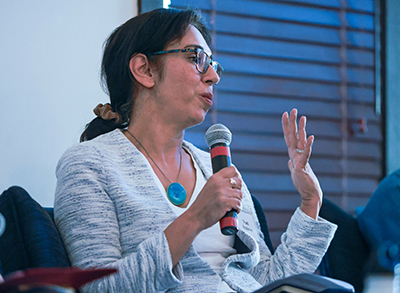
“I take my role as somebody who works at YouTube with a great sense of responsibility,” Henderson said, “because I’m helping to build products not only for my kids and my neighbors’ kids, but for your kids and kids all over the world.”
Panelists agreed that bans alone — whether on phones or AI tools — are a starting line, not a solution.
May, who works directly with students and schools across the country, was direct about the reality on the ground.
“Whether you want to hear it or not, your kids are using AI,” she said. “It might not be happening in the school walls, but when they go home, it’s happening.”
She warned that fear-based approaches are driving teens toward apathy, which she called the real risk, greater than any single technology.
She pointed to one student so anxious about his school’s murky AI policy that he now records himself doing homework every night, just in case he needs to prove he didn’t cheat.
“Behind every screen is a child’s superpower,” May said, “and AI should be used to amplify that superpower, not replace it.”
May argued that the antidote to screen overuse isn’t more restriction — it’s genuine engagement.
“The opposite of AI is social connection,” she said, urging parents to invest in the real-world interests and relationships that can meaningfully compete with the pull of devices.

May also turned the anxiety conversation back on the adults in the room.
“The real anxious generation is you,” she told the audience, challenging parents to examine whether their fears are truly about their children or about their own discomfort with a world they don’t fully understand.
Rather than coming from a place of anxiety and fear, May encouraged parents to use technology as a window into their child’s interests. For example, she suggested asking a reluctant writer to narrate their essay aloud on a walk, then using AI to help shape that voice into a written draft, a way of letting the child’s authentic voice lead, with technology in a supporting role.
Expert tips
“We’re seeing from many countries that the bans aren’t working; that many of the cell phone policies might not be delivering on the promises they were made on, and so, we want to be here to find that solution space with all of you,” Odgers said before asking the panel to provide actionable advice for parents. These are their tips:
- Be positive about your child’s tech use. Ask what they love online and let them be the expert. You might be surprised.
- Walk the walk. Kids notice when parents scroll through dinner or check phones during bedtime stories.
- Start with yourself. Before addressing your child’s screen use, examine what is driving your own fear.
- Give teens a seat at the table. Involving young people in family tech conversations, and even school policy discussions, builds trust and better outcomes.
- Put your phone to bed before your child. Guarantee them your full, undivided attention at the end of the day.
- Remember Henderson’s reminder that “there’s no one-size-fits-all parenting.” Use the tools available on platforms like YouTube to set boundaries that reflect your family’s specific values, your child’s age and your own comfort level — not someone else’s rulebook.
- Take May’s advice to heart: “Find your joy” and help your child find theirs. When children are deeply engaged in something that excites them, whether cooking, historical costuming or building communities around shared passions, screens become a springboard rather than an escape.
- Forgive yourself. As Odgers put it: “So much of the time we look at the screen and think we can solve the problems our kids face there, but the solutions are much deeper.”
CERES also offers resources for parents, including:
- Navigating Social Media: A Teen Wellness Toolkit
- How Parents Can Support Youth Well-being Around Digital Media
- Age Appropriate Media for Kids and Teens — How YouTube Works
- Google’s Parental Controls and Family Link
- What We’re Getting Wrong About Teens and Tech
- California Teen Tech Council: Nominate a Teen
- Does Your Teen Want to be Part of Research?
- Media Moms & Digital Dads: A Fact-Not-Fear Approach to Parenting in the Digital Age
- Dreams of the Overworked: Living, Working and Parenting in the Digital Age
- 10 to 25: The Science of Motivating Young People
The full panel discussion is available on YouTube.
Event photos are available on Flickr. Videos and resources from other panels in the series can be found on the CERES website.
The final panel discussion in the “Raising the Next Generation in the Age of AI” series will be held Nov. 18 and will focus on AI, the future of work, and how to prepare children for a rapidly evolving landscape. The event is free and open to the public.