
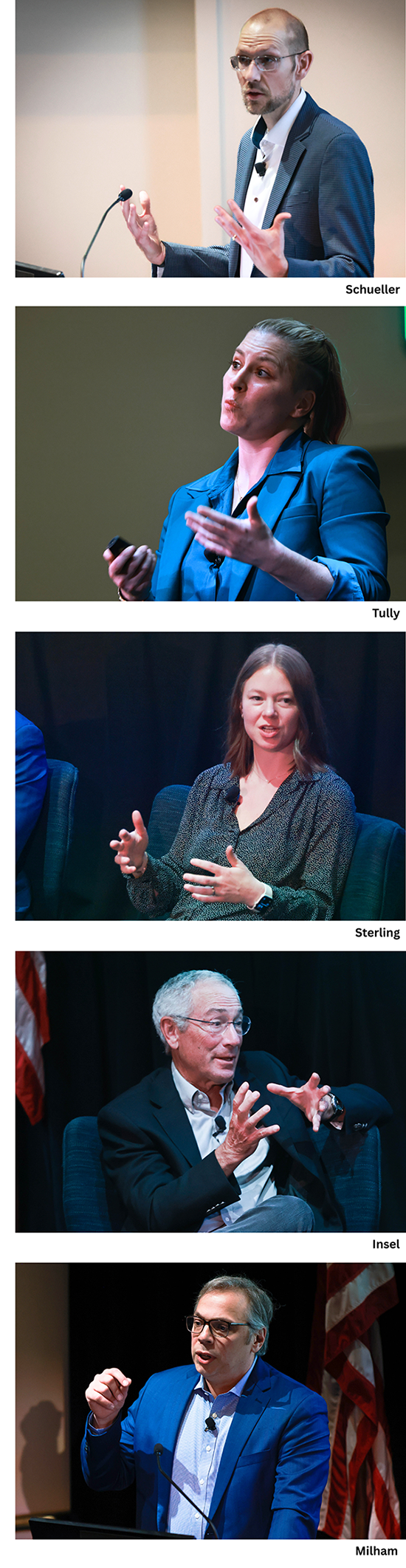
From left: Stephen Schueller introduces the panelists of the first “Raising the Next Generation in the Age of AI” series: Thomas Insel, Tully, Michael Milham and Rebecca Sterling. Photos by Karen Tapia
Inaugural series asks whether technology can raise a healthier generation
At 16, Tully looked fine from the outside. Inside, they were battling depression, self-harm, and suicidal thoughts — with no idea how to ask for help. Their brother Olly began experiencing psychosis at 13. It would be years before either found support.
 “What we lacked,” said Tully, now a Harvard-trained clinical psychologist and vice president of partnerships at Kooth Digital Health known as Dr. Tully, “was a door to mental health support that felt safe enough to walk through.”
Tully was one of four nationally recognized experts who spoke May 21 at UC Irvine during the launch of “Raising the Next Generation in the Age of AI,” a four-part series co-hosted by UCI’s School of Social Ecology, the Donald Bren School of Information and Computer Sciences, Office of Research, Connecting the EdTech Research EcoSystem (CERES), and Connected Learning Lab.
The opening session, “Digital Mental Health for Youth and Young Adults,” explored how the California Department of Health Care Services (DHCS) is building the kind of “door” Tully — and millions of young people like them — never had.
The need, said Rebecca Sterling, assistant deputy director of the Office of Strategic Partnerships at the California Department of Health Care Services (DHCS), is urgent and staggering. She opened with numbers that brought the room to a hush:
- Half of all diagnosable mental illness cases begin before age 14.
- Suicide rates among 10 to 18 year olds jumped 20% between 2019 and 2020.
- Before California launched its Children and Youth Behavioral Health Initiative (CYBHI), about two-thirds of young people with major depression received no care.
“We can’t afford to wait,” Sterling said. “Prevention and early intervention are critical components of an effective behavioral health ecosystem.”
$4 billion investment
CYBHI is a more than $4 billion investment under Gov. Gavin Newsom’s 2022 Master Plan for Kids’ Mental Health.
Sterling outlined several digital cornerstones of the initiative, including BrightLife Kids, a free behavioral health platform for parents and caregivers of children ages 0-12, and Soluna, a free platform for teens and young adults ages 13-25. Both platforms now reach families in every California county and collectively serve more than half a million children and young adults.
Seventy-seven percent of BrightLife Kids users say it was their first-ever contact with behavioral health support. Forty-four percent of Soluna users access the platform outside business hours — a figure that underscores a theme that echoed throughout the session: young people in crisis don’t wait for office hours.
Tully, who leads statewide partnerships to integrate Soluna into schools and health systems, reported more than 175,000 youth registered on Soluna as of May 20, with more than 62,000 coaching sessions delivered.
A Northwestern University study showed statistically significant reductions in psychological distress, depression, anxiety, loneliness, hopelessness, suicidal ideation, and improved quality of life. These improvements, Tully noted, were present one month after joining the study and remained at the three-month follow-up.
“Those young people are experiencing meaningful improvements in their mental health that appear to be sticking with them over time,” Tully said.
Tools built for the hours clinics are closed
Dr. Michael Milham, chief science officer at the Child Mind Institute, presented a parallel suite of tools developed through CYBHI and a partnership with DHCS.
Among them: Mirror, an AI-enabled journaling app that detects risk in real time, then immediately deletes entries to protect privacy. The app has more than 200,000 downloads and has facilitated more than 4,500 real-time reach-outs for care — most between midnight and 6 a.m.
“That’s the window that’s being missed when we just think of traditional clinical care,” Milham said.
A historic moment
Dr. Thomas Insel, former director of the National Institute of Mental Health and author of Healing: Our Path from Mental Illness to Mental Health, set aside prepared remarks to reflect on what he called a historic shift.
He framed the state’s work around “three Ps”:
- Population health — reaching youth beyond the clinical system.
- Place-based strategies — meeting youth in schools, on phones, and during the hours clinics are not open.
- Payment reform — including California’s pioneering multi-payer CYBHI Fee Schedule program that lets schools bill Medi-Cal for services they were already providing but couldn’t sustain.
“No one’s ever done this before,” Insel said. “This is the biggest single effort for child and youth mental health that anyone’s ever taken on.”
The panel did not shy away from difficult questions: the risks of unregulated AI chatbots, whether quality can keep pace with access, and how to ensure digital access connects seamlessly to broader care systems.
No one suggested the problems were solved, but the momentum, they agreed, is real.
Moderator Stephen Schueller, UCI professor of psychology and informatics and one of the world’s leading researchers on digital mental health, closed the evening with a straightforward call to action: build on what works and keep improving.
Added Candice Odgers, associate dean of UCI’s School of Social Ecology: “Supporting young people growing up in the age of AI is a massive, massive undertaking, and no one can do it alone.”
What’s next
The series continues with a July 16 session focused on play, followed by a Sept. 8 session on parenting teens and tweens in the digital age and a Nov. 18 session on preparing youth for the workforce of the future.
— Mimi Ko Cruz
Watch the full event on YouTube