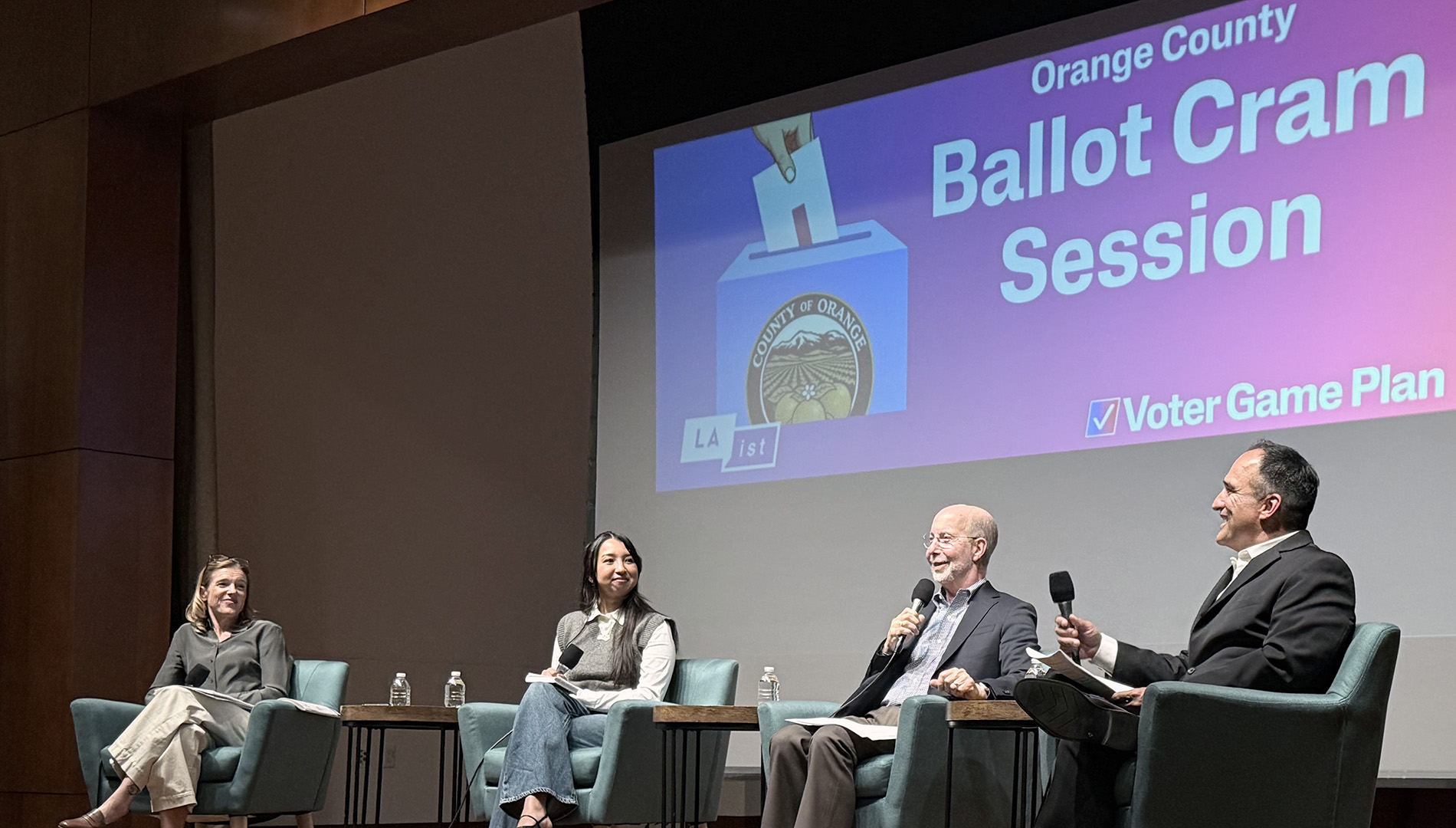
From left: Jill Replogle, Destiny Torres, Jon Gould and Michael Moodian.
Dean Jon Gould breaks it down at LAist cram session
By Mimi Ko Cruz
Jon Gould broke it down for the Orange County voters who packed a Corona del Mar senior center on Oct. 13: the ballot is long, the propositions are complicated, some of them designed that way on purpose.
The dean of UC Irvine’s School of Social Ecology was a featured expert at the LAist Orange County Ballot Cram Session, a free event hosted by reporters Jill Replogle and Destiny Torres at the OASIS Senior Center. Gould and Michael Moodian of Chapman University walked the audience through 13 statewide propositions, two Board of Supervisors runoffs, and a ranked choice voting measure in Irvine — pulling no punches along the way.
Here is a rundown of the statewide measures:
- Proposition 1 – Affordable Housing Bond, authorizes $11.25 billion in bonds for affordable housing, with $1.25 billion set aside for veterans. Gould called it “one of the most straightforward propositions on the ballot,” but cautioned that the veteran angle is somewhat overstated. “This is really less about veterans than it is about general affordable housing in California,” he said. Polling at around 55 percent.
- Proposition 2 – Rainy Day Fund, would raise the cap on how much of the state’s general fund can be saved, from 10% to 20%. Gould noted it has unusual bipartisan support — Newsom and the legislative Democrats back it, but so does the Los Angeles Chamber of Commerce and firefighters. Polling at about 60%, which Gould said makes it likely to pass. When asked if it would ease the strain on local budgets, Gould was succinct: “No. Full stop.”
- Proposition 3 – High Income Tax Rate Made Permanent, would make permanent the income tax surcharge on high earners — roughly those making more than $370,000 for single filers — that voters first passed in 2012 and extended in 2016. If it expires in 2031, the highest rate of 12.3% would drop to around 9%. About 89% of revenues go to K-12 schools and 11% to community colleges. Polling at 58%. Replogle offered this context: “If this gets rejected and the tax rate goes back to what it was before 2012 for those highest income earners, someone who makes $3 million a year would be taxed at the same rate as somebody who makes $73,000 a year.”
- Proposition 4 – Public Funding for Elections, would allow state and non-charter local governments to use taxpayer money to fund candidate campaigns, a system already in place in about five or six charter cities including Berkeley. Polling poorly — 42% in one survey, 35% in another. Gould said voters appear to be reacting viscerally: “Ugh, politicians, I don’t want to spend money on them.” Supported by the League of Women Voters and Common Cause but largely flying under the radar.
- Proposition 5 – Recall Reform, would separate the question of recalling an official from the vote to replace them, requiring a special election for any successor. Gould traced the issue back to the Josh Newman and Gray Davis recalls, where replacement candidates won with as little as 30 to 33% of the vote. “I don’t see this winning,” Gould said. Not polling well, and opposed by the Republican Party.
- Proposition 37 – Home Buyer Loan Assistance, a $25 billion revenue bond program offering middle-income buyers a fixed-rate second mortgage of up to 17% of a new home’s price, with buyers still required to put 3% down. The state would essentially act as a mortgage broker, Gould said. “People who want a house who can’t afford a house are not spending a whole lot of time asking about the geopolitical or larger economic issues. They’re asking, how can I afford a house?” Strongly backed by realtors and the construction industry. Polling well, with Gould calling it “probably passable,” though he noted buyers would be leveraged at 97% of their home's value.
- Proposition 38 – Medical Research Bond, an $8.4 billion bond for cancer, Alzheimer’s, and other disease research. Half the money would go to a specific UCLA-affiliated institute backed by the proposition’s primary funder, Gary Michaelson, who has put in $43 million of the $51 million raised, Moodian said. Gould declined to comment directly, saying simply, “Since I am employed by the University of California, I’m going to say nothing.”
- Proposition 39 – Voter ID, would require government-issued photo ID at the polls and the last four digits of an ID on mail-in ballots, and direct election officials to cross-check voter rolls with citizenship data. “There is simply no evidence anywhere in America of widespread voter fraud. There just isn’t,” Gould said, though he acknowledged a secondary argument, that showing ID adds a sense of civic integrity to voting. California-based pollsters show it failing by large margins; some out-of-state pollsters show it winning. Gould said it is one to watch on election night. Driven by the California Republican Party and opposed by Democrats.
- Proposition 40 – One-Time Billionaire Tax, would impose a 5% tax on the assets — not income — of Californians with a net worth over $1 billion. Revenues would go primarily to healthcare, with some going to education and food assistance. Despite what would seem like a politically easy sell, it is currently polling below 50%. “This goes against everything I thought I knew about political science,” Gould said. “I thought voters would say, ‘Oh my God, we need money. It’s going to education. It’s going to healthcare. And it’s billionaires — sign me up.’ And, at the moment, it sure doesn’t look like that.” Supported by Senator Bernie Sanders; opposed by Gov. Gavin Newsom and establishment Democrats.
- Proposition 41 – Pre-Vote Tax Audit Requirement, would require the state auditor to review any special tax proposal before it goes to voters. Gould said this is the most technically difficult proposition to understand, but the cleaner way to grasp it is this: a yes on 41 is effectively a no on Prop. 40, since it would nullify the billionaire tax if both pass. Funded heavily by billionaires opposing Prop. 40. Currently polling worse than Prop. 40 itself.
- Proposition 42 – Ban on Personal Property Taxes, would prohibit new state taxes on personal property — not real estate — and ban retroactive taxes. Like Prop. 41, it is designed to undercut Prop. 40, and is heavily funded by tech billionaires including Google co-founder Sergey Brin. Gould noted that it has produced its own strange political coalition: technology investors and business groups are aligned with construction trade unions, firefighters and police, who are worried about retirement accounts. “If you are confused, that was intentional by the people who wrote 41 and 42, because they are trying to muddy the waters on 40.”
- Proposition 43 – Two-Thirds Threshold for Local Special Taxes, would require a two-thirds voter approval for citizen-initiated local special taxes, up from a simple majority. Already failing badly in polling. Gould noted an irony: though it sounds like a citizen-led idea, it was placed on the ballot by the legislature in a deal to head off something more restrictive from the Howard Jarvis Taxpayers Association.
- Proposition 44 – Community Clinic Spending Rule, would require nonprofit community health clinics to spend 90% of their revenues on direct patient care or face fines. Currently losing 2-to-1 in the only available poll.
- Proposition 45 – CEQA Reform, would impose roughly a one-year deadline on environmental reviews and legal challenges for so-called essential projects including housing, roads, schools, broadband, and wildfire mitigation. Polling about 50-50. “If it weren’t for the housing crisis right now, I don’t think 45 would be on the ballot, and I don’t think it would pass,” Gould said. “But given the housing crisis that we’re having, this one’s really in play.” Supported by developers, utilities and the chambers of commerce; opposed by environmental groups and some labor unions.
Orange County Board of Supervisors races
On the Board of Supervisors, Gould called the District 5 race between incumbent Democrat Katrina Foley and former Newport Beach Mayor Diane Dixon “probably the most competitive of any of the races we are going to see in Orange County in 2026.”
He pointed to a notable wrinkle: outgoing Democratic supervisor Doug Chaffee has not endorsed Foley and is listed as a supporter on Dixon's website — a move Gould called “the controversy that is hiding in plain sight in this race.”
Foley has out-raised Dixon roughly 3 to 1, pulling in about $3 million largely from public employee and police and fire unions.
In District 4, which covers Brea, Fullerton, and parts of Anaheim, Democrat Connor Trout faces Republican Tim Shaw for the seat being vacated by Chaffee.
Democrats hold a roughly 10-point registration advantage in the district, though Gould cautioned that advantage has not always translated into wins.
Ranked choice voting
The panel closed with a discussion of an Irvine initiative to adopt ranked choice voting for city council and mayoral races — a measure endorsed by the Irvine mayor and opposed by the vice mayor. Gould said if it passes and voters embrace it, it could become a model for other California cities.