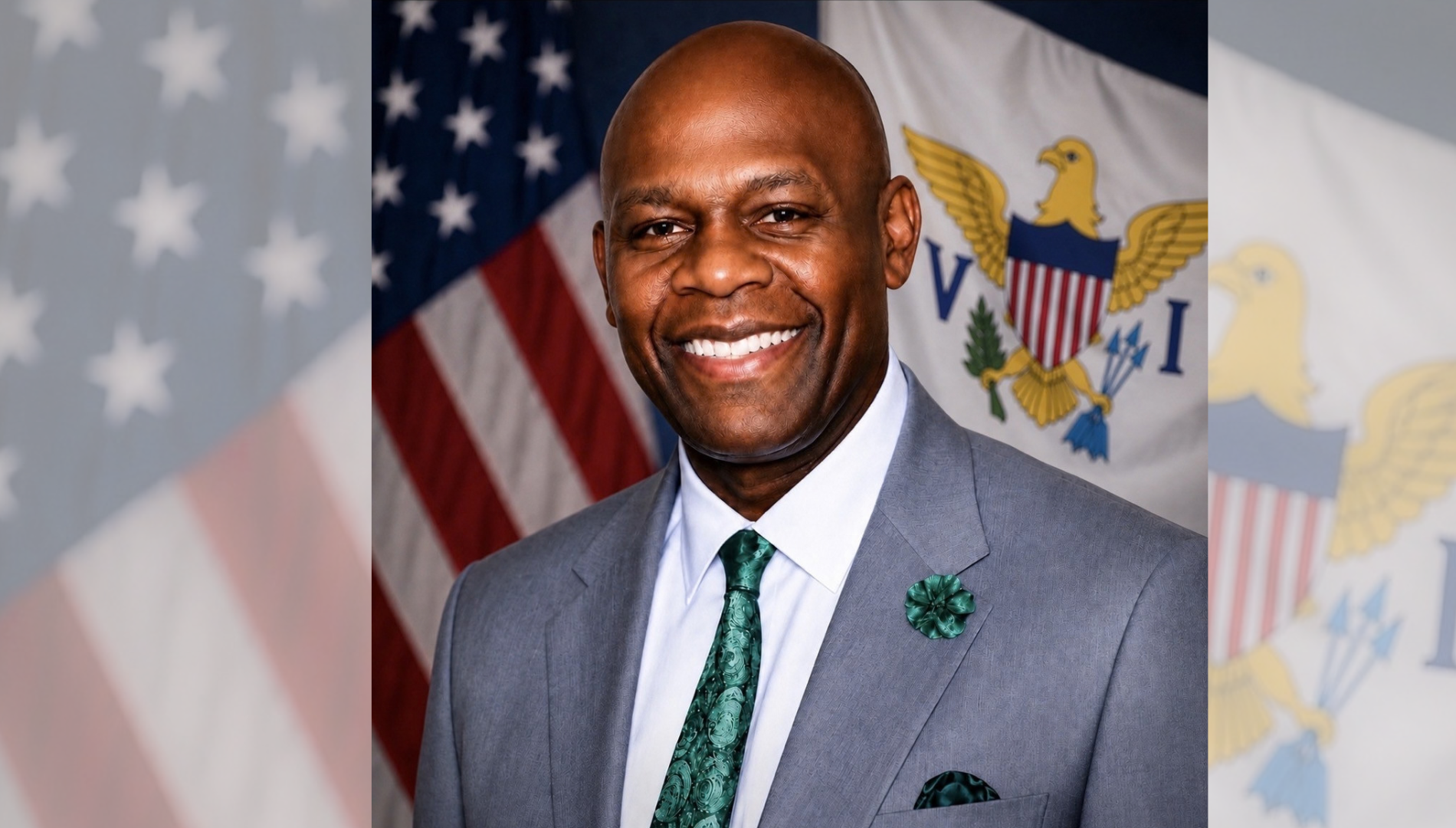
Moleto A. Smith Jr. ('87, B.A. social ecology with a concentration in criminal justice) is shown in his official portrait as Chief Criminal Justice Policy Advisor to the Governor of the U.S. Virgin Islands. [Inset:] Smith's UCI class photo from 1986-87 school year.
How a Social Ecology degree fueled Moleto Smith’s four-decade career in public service
By Matt Coker
When Moleto A. Smith, Jr. arrived on the UC Irvine campus in 1982, the university was vastly different from the thriving research powerhouse it is today.
“When I was in Irvine during that time, it was a transitioning university,” Smith recalls. “Most of what you see now as the developed institution that it is was mainly agricultural land in its grounding.”
Yet, within that evolving landscape, Smith found an intellectual home that would define his life’s work: the School of Social Ecology.
How does a young student from the Caribbean end up in Southern California? Following a move by his mother from the East Coast, Smith completed his senior year at Buena Park High School — where he served as the graduation speaker — before turning his sights to higher education. Initially aiming for a path in architectural engineering, he ultimately chose UCI.
 “I ended up applying to Irvine in social ecology because it had the urban planning component, which incorporated some aspects of architecture,” Smith explains. “After applying and being accepted, I drifted toward criminal justice because I had intentions of becoming an attorney.”
Though he ultimately opted against law school after scoring highly on the LSAT, his focus turned toward human behavior, research, and systemic reform — a pivot that set the stage for a remarkable career. Armed with a Bachelor of Arts in Social Ecology with a concentration in Criminal Justice (Class of ’87), Smith went on to accomplish what many assume requires an advanced degree: four decades of transformational leadership, institutional turnarounds, and Cabinet-level public service.
Today, Smith serves as Director of the U.S. Virgin Islands Law Enforcement Planning Commission (LEPC) and statutory Chief Criminal Justice Policy Advisor to the Governor. In this Cabinet-level role, he oversees millions of dollars in federal Department of Justice grants, directs strategic criminal justice planning, and leads violence prevention and juvenile justice initiatives across the territory. Among his most significant achievements at LEPC was orchestrating critical compliance reforms that successfully removed the agency from a U.S. Department of Justice “high-risk” designation.
His current role in criminal justice is just one chapter in a broad, interdisciplinary career. Smith spent nearly two decades with the Virgin Islands Department of Human Services, serving as Deputy Commissioner of Planning & Operations and as Interim/Acting Commissioner, where he managed over 1,000 employees and a $100 million budget. Later, as Executive Director and CEO of the St. Thomas East End Medical Center Corp., he led the federally qualified health center through major expansions in primary care, dental, and behavioral health services — and successfully steered the organization through the devastation of Hurricanes Irma and Maria and the COVID-19 pandemic without a single layoff. His leadership also extends across borders, having served as Chairman of the Board of Directors for the British Virgin Islands Health Services Authority.
Throughout these diverse sectors — healthcare administration, emergency management, human services, and public safety — Smith attributes his interdisciplinary effectiveness to the core principles he absorbed at UC Irvine.
“Social ecology is the foundational approach that I take to my executive style, policy development, and overall executive work,” he explains. “It is very foundational in how I approach things.”
This cross-system mindset proved invaluable when he took his passion for public service to the highest political stage, running for Governor of the U.S. Virgin Islands twice. Reflecting on those campaigns, Smith views the political arena through the same analytical and empathetic lens he applies to policy work.
“It allows an astute candidate to really see the various dimensions of human personality,” he says. “I think there are few things as authentic as political expression among the people who you seek to serve.”
As for whether he might run again, Smith is characteristically measured: “It’s always in the back of your mind. I wouldn’t say I would not consider it again — it’s just not in the forefront of my thinking right now.”
Beyond his executive duties, Smith remains deeply committed to workforce development, policy research, and mentoring the next generation of leaders. He returned to the UCI campus just last year for a conference, walking grounds he once knew as open fields, and came away with a renewed appreciation for how far both the institution and his own journey have traveled.
For Smith, that journey — from the classrooms of Social Ecology to the cabinet rooms of territorial government — is ultimately a testament to what a rigorous, research-grounded education can do for a life fully committed to public service. As he puts it:
“When you really look at the transformation of UC Irvine and the social ecology program, and how it has become a major contributor to quality-of-life research and policy — in Southern California, in Orange County, and elsewhere — you really understand the value of a strong, research-based higher education. It lays the foundation for so many things for folks who take that path and decide to apply it in their everyday life and work. UCI really provided the foundation for how I approach not only my work, but my general lifestyle.”