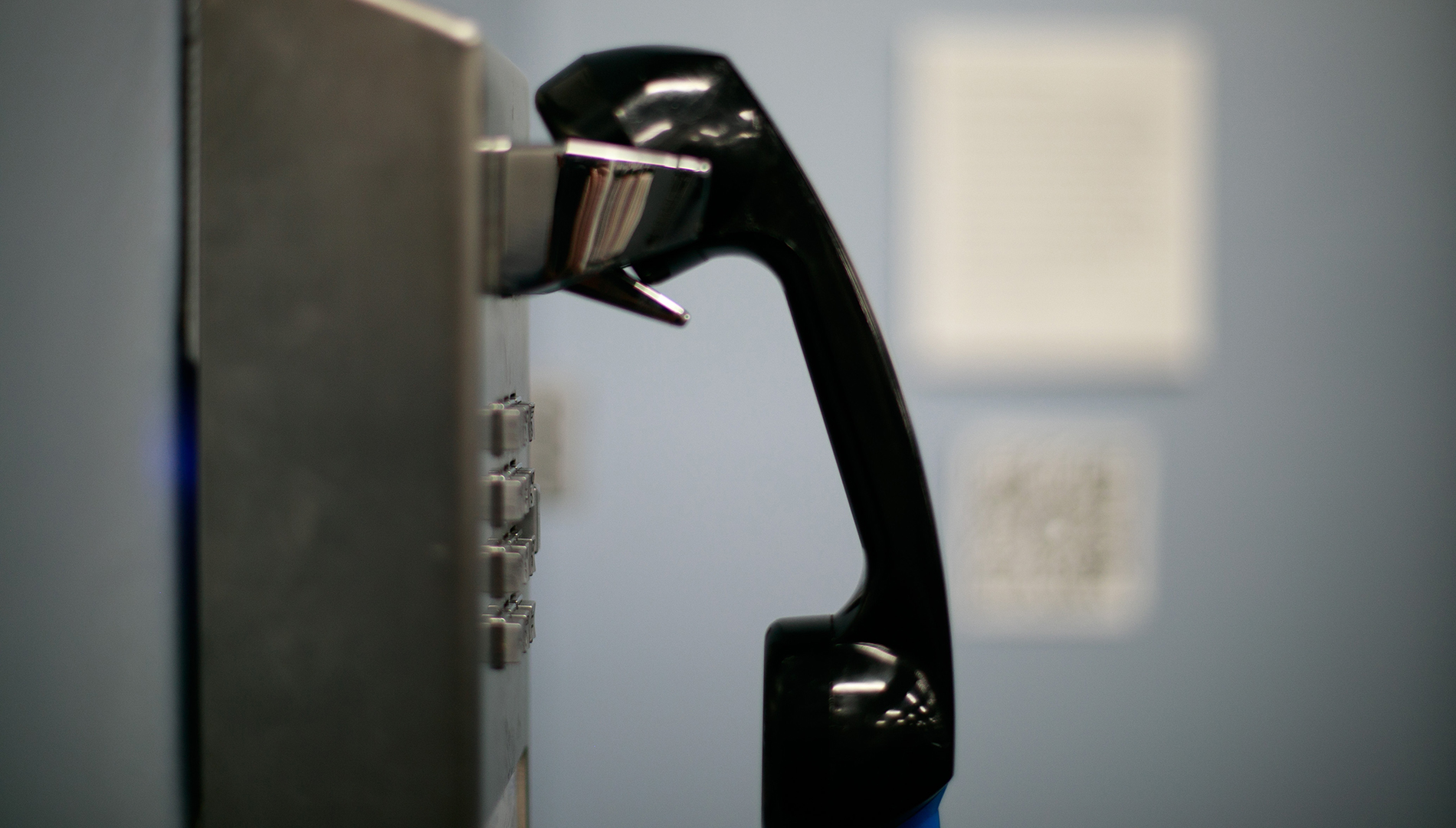
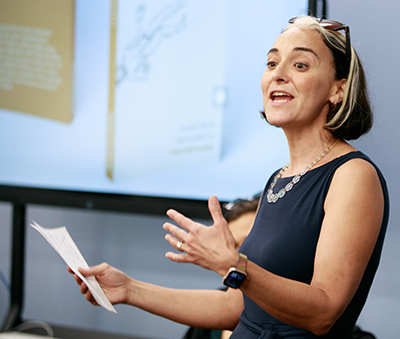
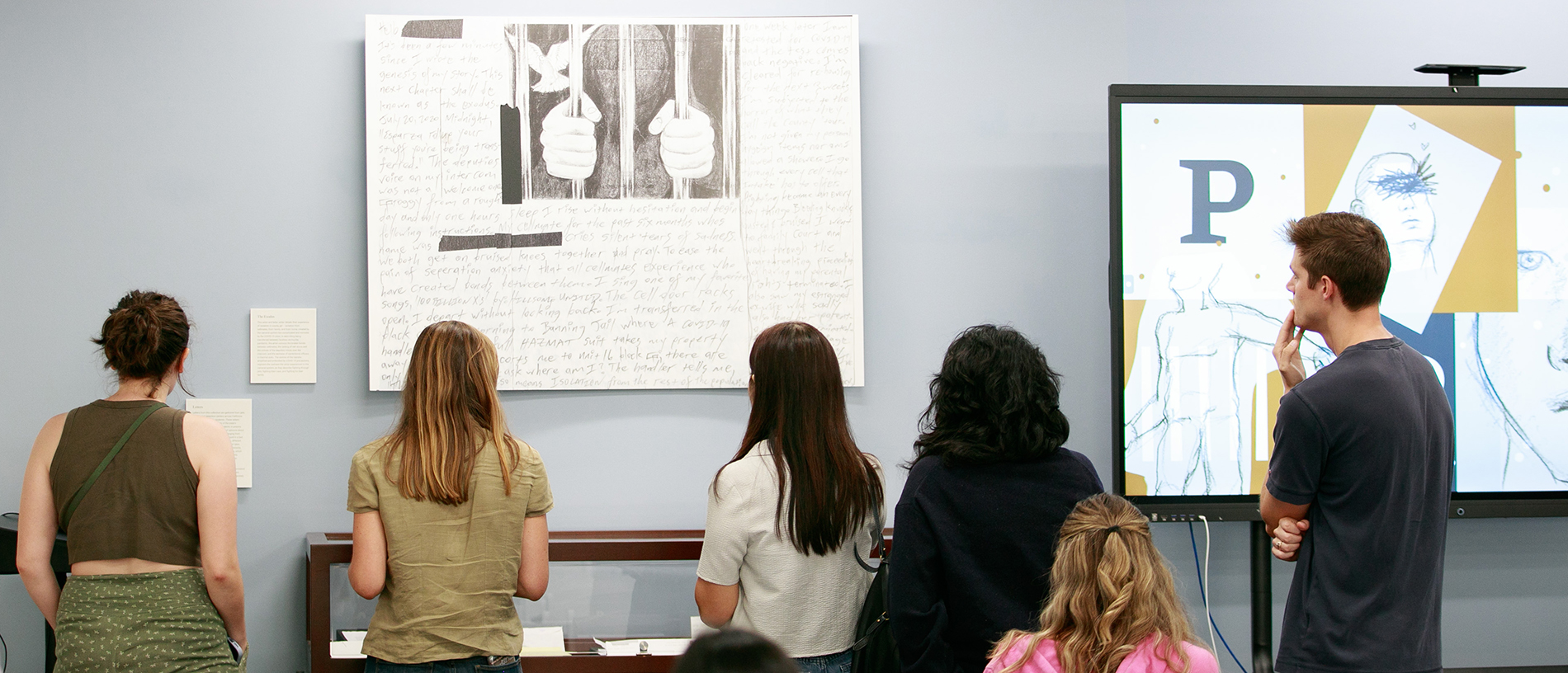
The PrisonPandemic exhibit is on view through Dec. 11 in the Orange County & Southeast Asian Archive exhibit space. Inset images from top: Keri Blakinger, Andrea Armstrong, Keramet Reiter and event-goers taking in the exhibit. Photos by Han Parker
Event confronts the hidden realities of dying behind bars
By Mimi Ko Cruz
Pick up the phone. You hear a voice. Not a dial tone. A person. Someone who was locked away during the COVID-19 pandemic, cut off from family, from doctors, from the world. Someone whose story might never have been told.
That is the experience waiting for visitors to UC Irvine’s PrisonPandemic exhibit this fall — and it was the spirit that animated a powerful evening on Oct. 1, when UCI's Illuminations: The Chancellor's Arts & Culture Initiative brought together a documentary film, two of the country’s most compelling voices on criminal justice, and an archive built from thousands of letters and phone calls from behind bars.
The event began with a screening of “I Am Ready, Warden,” the Oscar-nominated short documentary that chronicles the final days of John Henry Ramirez, a Texas death row prisoner convicted of murder in 2008.
In 37 unflinching minutes, the film traces the legal machinations surrounding Ramirez’s execution, including his landmark Supreme Court case over the right to have a chaplain present at his death, and the slow erosion of his faith, hope and sense of self under the weight of the state’s prolonged pursuit of his death.
 “By the time I saw him that last summer, he wasn’t his chipper self,” recalled Keri Blakinger, the acclaimed investigative journalist who produced the film and covered Ramirez’s case for years.
Speaking during a discussion that followed the screening, Blakinger described watching Ramirez transform from a man who spoke with radiant certainty about the afterlife into someone who told her, near the end, that he hoped he was wrong about heaven — that he hoped death was simply darkness.
“The state had taken this man’s faith,” she said. “That was one of the darkest things I have seen in covering executions. It’s just a bottomless pit, how much the state can take.”
Blakinger was joined by Andrea Armstrong, a MacArthur “Genius” grant recipient and law professor at Loyola University New Orleans celebrated for her meticulous documentation of deaths in Louisiana prisons and jails.
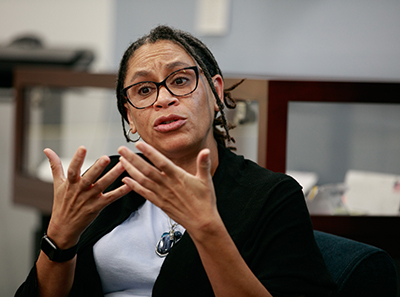 Armstrong talked about the slow, systemic casualties of incarceration: the absence of vegetables on a meal tray, the mother left standing outside a prison gate after her son has died inside, the questions no one thinks to ask.
“These are facilities operated in all of our names, on all of our tax dollars,” Armstrong said. “You should call your local sheriff. Call them monthly. Ask what was on the menu last night. Ask how many people are incarcerated. They may not answer but, when someone starts asking the same question over and over, internally, people start paying attention.”
The conversation was moderated by Keramet Reiter, UCI professor of criminology, law and society who co-founded the PrisonPandemic project with Kristin Turney, UCI Distinguished Professor of sociology, Naomi F. Sugie, UCLA professor of sociology, Joanne DeCaro, UCI alumna (’25 M.A. social ecology and ’26 Ph.D. criminology, law and society) and assistant professor of criminology and criminal justice at University of Missouri, St. Louis, and Gabe Rosales, who earned his Ph.D. in criminology, law and society from UCI this year.
The speakers explored the challenge of making visible what often is kept hidden and the moral stakes of that invisibility.
 Attendees gathered in the same space as the newly opened PrisonPandemic fall exhibit, where four refurbished prison phones hang on the walls, each one a portal into a world most people will never see.
Pick one up, and you hear it: the actual recorded voices of people incarcerated in California during the COVID-19 pandemic, sharing what it felt like when the prison doors closed to the outside world and did not reopen for more than a year.
What began in the earliest, most frightening days of the pandemic, when a social worker at San Quentin raised the alarm about incarcerated patients with no protective equipment, no room to distance, no way to quarantine, has grown into an archive of about 4,700 stories gathered through hand-written letters and phone calls from all 35 California state prisons, county jails, and other carceral facilities across the state.
By the summer of 2020, 2,000 people at San Quentin alone had contracted COVID-19.
Twenty-nine died.
The prison became, as that social worker had feared, the site of one of the worst outbreaks anywhere in the world.
The exhibit brings that history to life through art, letters, ephemera and those audio recordings — each prison phone returning to visitors an object that, for incarcerated people, represented the thin thread connecting them to the people they loved.
The PrisonPandemic exhibit, which is open to the public, will remain on view through Dec. 11 on campus in the Orange County & Southeast Asian Archive exhibit space. Admission is free. Check the OC&SEAA website for hours.
For those who cannot visit in person, the PrisonPandemic website offers the full archive, newly expanded with improved search tools, thematic collections, contributed artwork, Spanish-language accounts, and 10 teaching modules designed to bring incarcerated voices into classrooms and research.
“Hearing the phone calls and reading the letters brings the direct, unfiltered experiences of incarcerated people into research and into the classroom,” Reiter said. “Our hope is that researchers and educators will draw from this archive to give voice to an often hidden and inaccessible group of incarcerated people and their family members.”
The opening event made clear that giving voice to the hidden is not simply an act of scholarship, she said, adding that it is an act of accountability and for those willing to pick up the phone and listen, perhaps even an act of transformation.