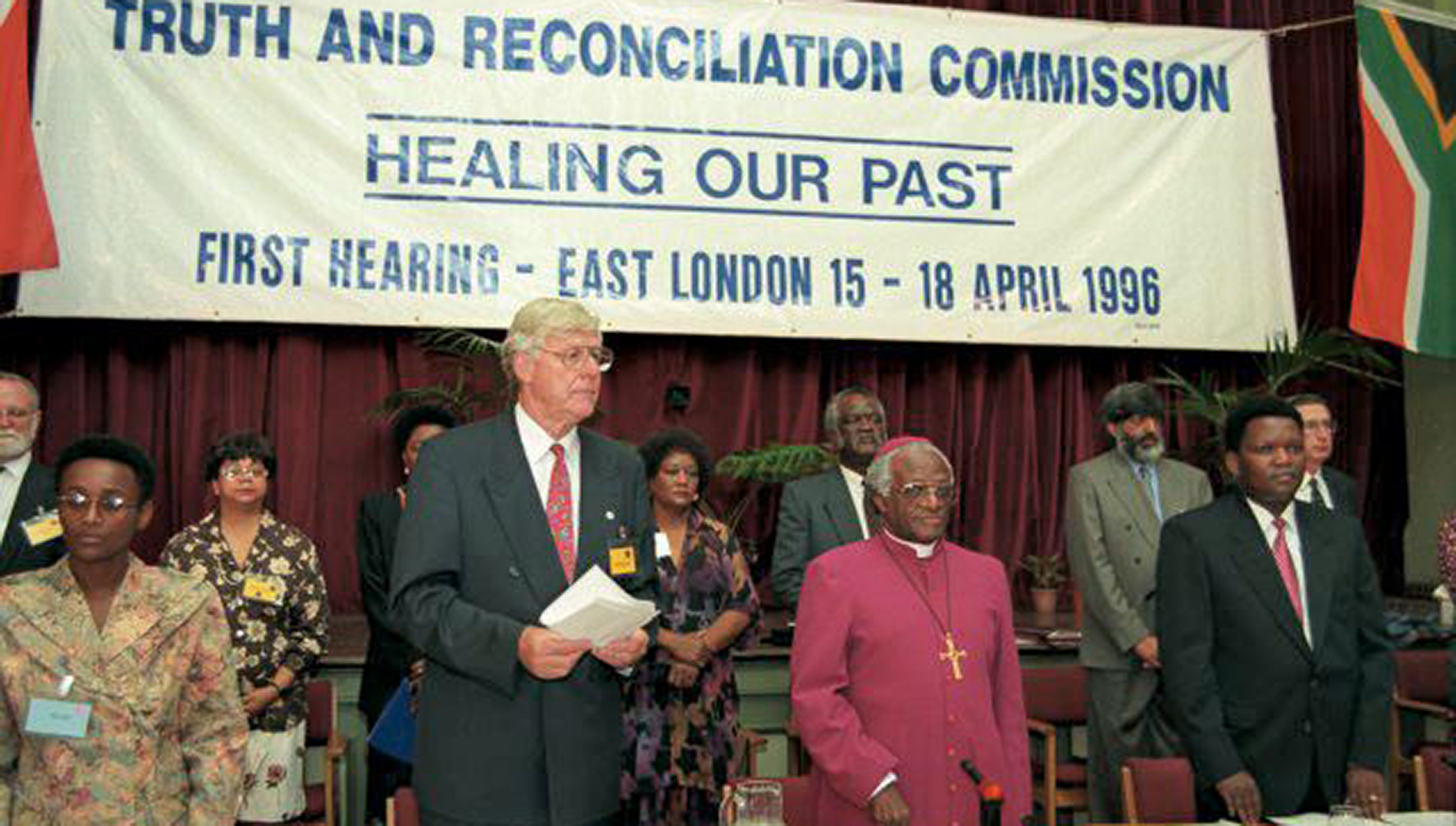
South Africa’s Truth and Reconciliation Commission was led by Archbishop Desmond Tutu, third from left, front row. The court-like restorative justice body was created in 1995 after the end of apartheid. It produced a broadly accepted factual record. Photo credit: South African History Online
Gould proposes a South Africa-style process to rebuild trust
By Mimi Ko Cruz
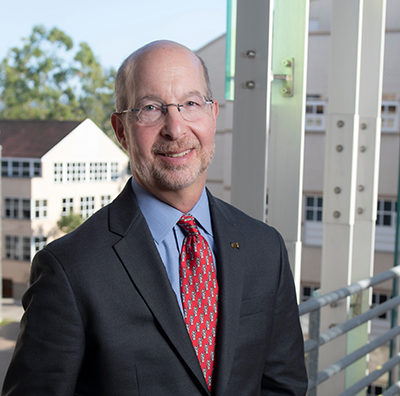
As newly emboldened Democrats weigh how aggressively to investigate the Trump administration, Jon B. Gould, dean of UC Irvine's School of Social Ecology, has some advice: “don’t just investigate, investigate, investigate. Prepare for something bigger.”
In “On Truth and Reconciliation in America,” published in the November edition of Current History, Gould argues that the country should begin planning now for a national truth and reconciliation commission, modeled in part on South Africa’s. It would convene after President Donald Trump leaves office.
Gould warns that a broad campaign of partisan probes now would deepen the distrust it aims to fix.
“If the country reaches that moment without having debated what accountability should look like, the response will be improvised and driven by partisan anger,” Gould writes. “That is how democracies make their worst decisions.”
More than the charges against the Trump Administration, he says the problem is a widespread belief that “the rules no longer apply equally.”
He first saw it in his own classroom. Last year, he asked about 40 students in his class on the future of California, about half of them first-generation college students, how many still believed in the American Dream. Only five raised their hands.
“They felt like, and this is in their words, not mine, that the system is rigged,” Gould says in an interview on the UC Institute on Global Conflict and Cooperation/Current History “Talking Policy” podcast that aired today.
The students were looking at the Trump administration, he says, but “they also were savvy enough to appreciate that the crisis didn’t begin with him.”
They also pointed to the Jeffrey Epstein scandal as proof that the well-connected evade scrutiny. In fact, a February 2026 Reuters poll found that 70% of Americans believe the powerful are rarely held accountable.
Congress has largely abandoned serious oversight, Gould notes.
In 2024, the Supreme Court ruled in Trump v. United States that presidents have broad immunity for official acts. Criminal trials are built to decide individual guilt, not to expose systemic failures. And, prosecutions are often dismissed as witch hunts.
“Accountability stops looking like justice and begins to resemble partisan warfare conducted through legal institutions,” Gould writes.
A truth commission would work differently, he argues, and points to South Africa’s truth commission, chaired by Archbishop Desmond Tutu. Authorized by Nelson Mandela, the commission was a court-like restorative justice body created in 1995 after the end of apartheid. It held televised hearings over more than two years and heard from more than 21,000 victims, granting conditional amnesty to about 850 perpetrators who fully disclosed their crimes. The process produced a broadly accepted factual record.
“At a moment when Americans cannot agree on basic facts, this may be the TRC’s most important lesson,” Gould writes.
With subpoena power, an American commission could ask donors, lobbyists, consultants and officials how access and influence were traded. Its aim would be to establish what happened and recommend reforms, not simply to punish. Reforms could include limits on the pardon power, tighter rules on officials profiting from office, and changes to campaign finance and lobbying.
A commission practically can’t go forward while a sitting president is among the subjects of its inquiry and Republicans would have to be willing to look inward, Gould says. Plus, Democrats would have to resist the temptation to use the commission for revenge. Both are tough sells, he acknowledges.
“This is ultimately about trying to figure out what went wrong and to prevent corruption in the future, not simply to score points,” Gould says on the podcast, describing the stance he hopes Democratic leaders will take.
He acknowledges that pardons could limit who testifies. But, he notes that a president “can’t pardon everybody,” and that lower-level figures might talk in exchange for amnesty. State-level efforts, such as coordinated action by attorneys general, could also reach conduct a presidential pardon can not.
Gould says the stakes extend beyond any one administration.
“Democracies cannot recover if citizens fundamentally disagree about what actually occurred,” he writes. “Truth can create the conditions for reform, but it cannot substitute for reform itself.”
Whether a commission can succeed is unknown, he says. “Is it likely to succeed? We’ll find out, but the only way we find out is if we try it.”
Related
Current History article by Jon Gould: On Truth and Reconciliation in America