
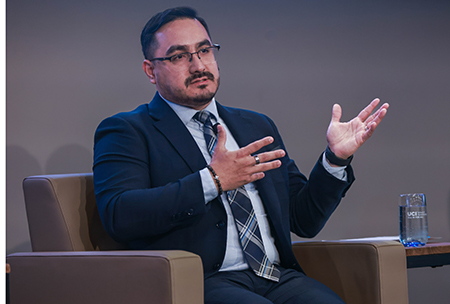
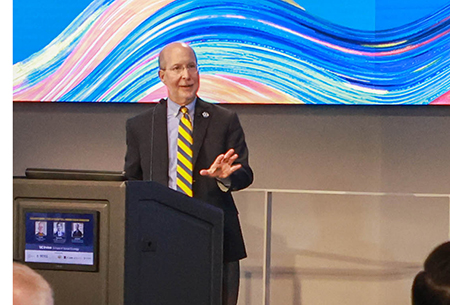
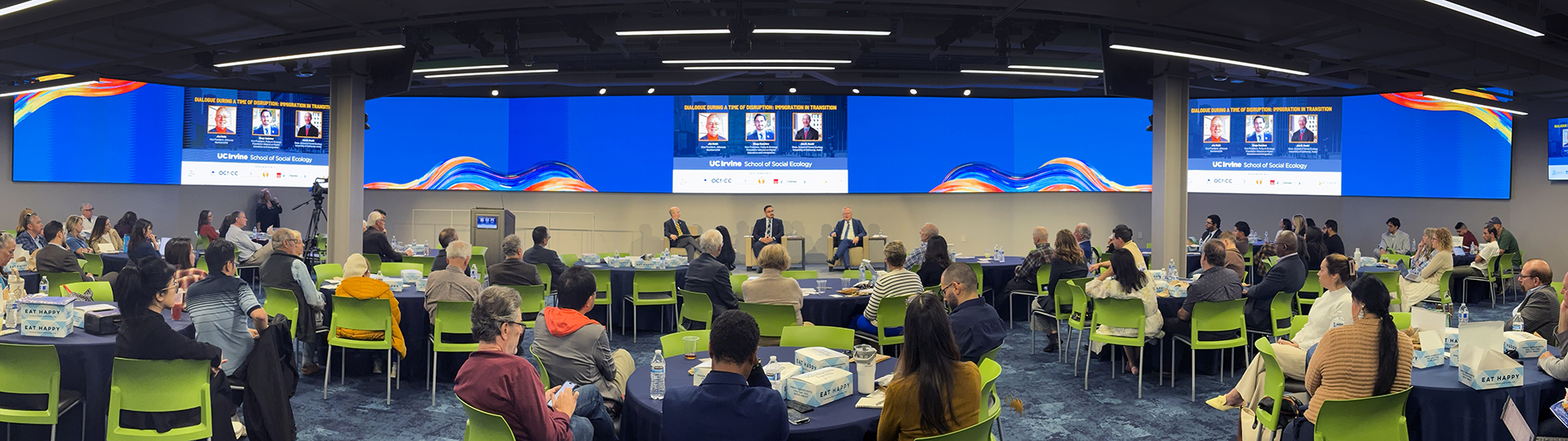
The second “Dialogue During a Time of Disruption” event featured speakers Diego N. Sánchez, center, and Jim Robb, right. Dean Jon Gould moderated the discussion. Photos by Karen Tapia
‘Dialogue During a Time of Disruption’ addresses immigration
Two of the nation’s leading immigration advocates, representing opposing ends of a deeply polarized debate, sat down together at UC Irvine on May 5 and delivered a message few expected: both sides have failed — and only by working together can they fix it.
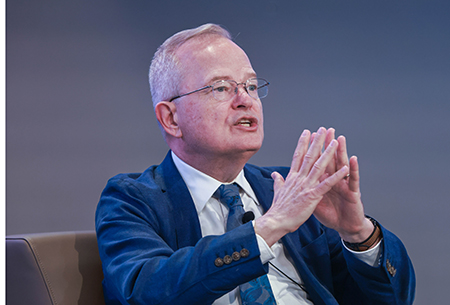 Jim Robb, vice president of alliances at Numbers USA, and Diego N. Sánchez, vice president of policy and strategy at the Presidents’ Alliance on Higher Education and Immigration, appeared before a packed audience as part of the School of Social Ecology’s “Dialogue During a Time of Disruption" series. Rather than debate, they spent 90 minutes searching for common ground.
“We’ve been fighting each other, speaking past each other for so long that we never got a chance to sit down and genuinely work on these issues,” said Sánchez, who revealed he was formerly undocumented. “I’m tired of fighting. I’m ready to sit down and discuss shared goals.”
Robb, whose organization has spent three decades blocking immigration legislation it opposed, framed the stalemate bluntly: “We’re in a situation of mutually assured destruction. I can stop anything anyone in this room wants to push through Congress. But you can stop anything we want to get passed. So nothing happens at all.”
 The event was organized in partnership with Braver Angels, a national organization dedicated to bridging America’s political divides, and was sponsored by ARK Clinical Research, Greater Irvine Chamber of Commerce, Newport Beach Chamber of Commerce, OC Forum, Orange County Business Council, Orange County Grantmakers, Orange County Hispanic Chamber of Commerce, Santa Ana Chamber of Commerce, and World Affairs Council of Orange County.
“If we are in our own echo chambers, talking only to each other about things we agree with, we’re not having a true conversation,” said Jon B. Gould, dean of the School of Social Ecology, who served as the event’s moderator. “Most importantly, we are not moving things forward in this country on issues that most matter to us.”
Robb and Sánchez serve together on Braver Angels’ Citizens Commission on Immigration, a first-of-its-kind effort that has convened national advocacy leaders across the political spectrum. Through 36 common ground workshops held across the country, the Commission has compiled nearly 1,000 unanimous points of agreement between Republican and Democratic participants — a remarkable result given the toxic state of the national debate.
 Both speakers agreed a crisis exists.
Sánchez cited more than 30 years without significant immigration reform, a backlog of more than 2 million asylum cases, and persistent congressional inaction.
“We've failed — not just Congress, but advocates as well,” he said. “We got caught up just fighting each other.”
Robb compared America’s polarized political system to a battlefield “mined so heavily that the pain of actually crossing it is too high.”
He argued that adopting European-style politics — one that treats opponents as enemies — has made the bipartisan compromise America’s system requires nearly impossible.
Robb and Sánchez agreed the asylum system needs more judges and personnel. But, on a path to legal status for undocumented immigrants, they diverged.
Sánchez supports citizenship for long-term residents, particularly those here more than 10 years, but acknowledged that the “citizenship or nothing” stance of immigration advocates has repeatedly failed politically. Robb drew a firm line at what he called “mass accommodation” of those who arrived during recent years of border chaos.
“I think it’s inadvisable to reward people who’ve beaten the system in a massive wave,” Robb said. “That’s not going to end well. It didn’t end well in 1986.”
The speakers called for a fundamentally reimagined immigration system — one flexible enough to adapt to changing economic realities.
Dean Gould closed by urging the audience to seek out difficult conversations with people who hold different views.
Robb offered a practical challenge: “Set up a roundtable and make sure everyone is different. If you give people a room who already agree with you, you're really not accomplishing anything.”
Jessica Stern, dean of the College of Humanities and Social Sciences at Cal State Fullerton, who attended the event, called it “a model of how to engage in potentially-fraught conversations with curiosity, respect and willingness to budge in the name of coming up with solutions.”
Robb and Sánchez, she added, “clearly held different positions on fundamental questions: Should specific immigration categories have preference? Which family members of citizens should have priority? What is the place of asylum in our immigration system? And, yet, they were able to navigate these thorny questions with respect and trust.”
The discussion was the second in the “Dialogue During a Time of Disruption” series. The first took place last year and focused on America’s identity crisis.
The latest dialogue is available on YouTube.
Event photos are available on Flickr.