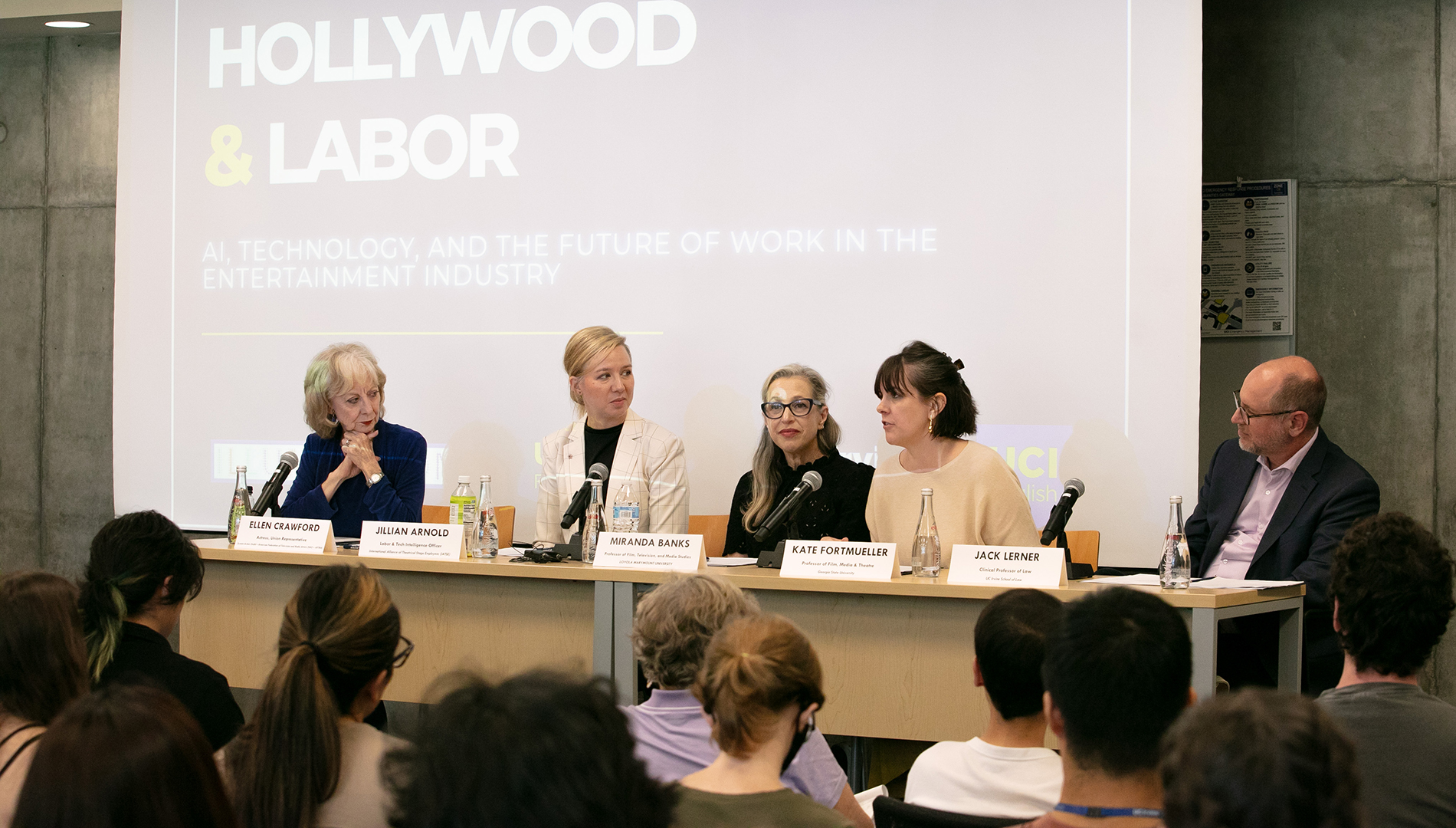
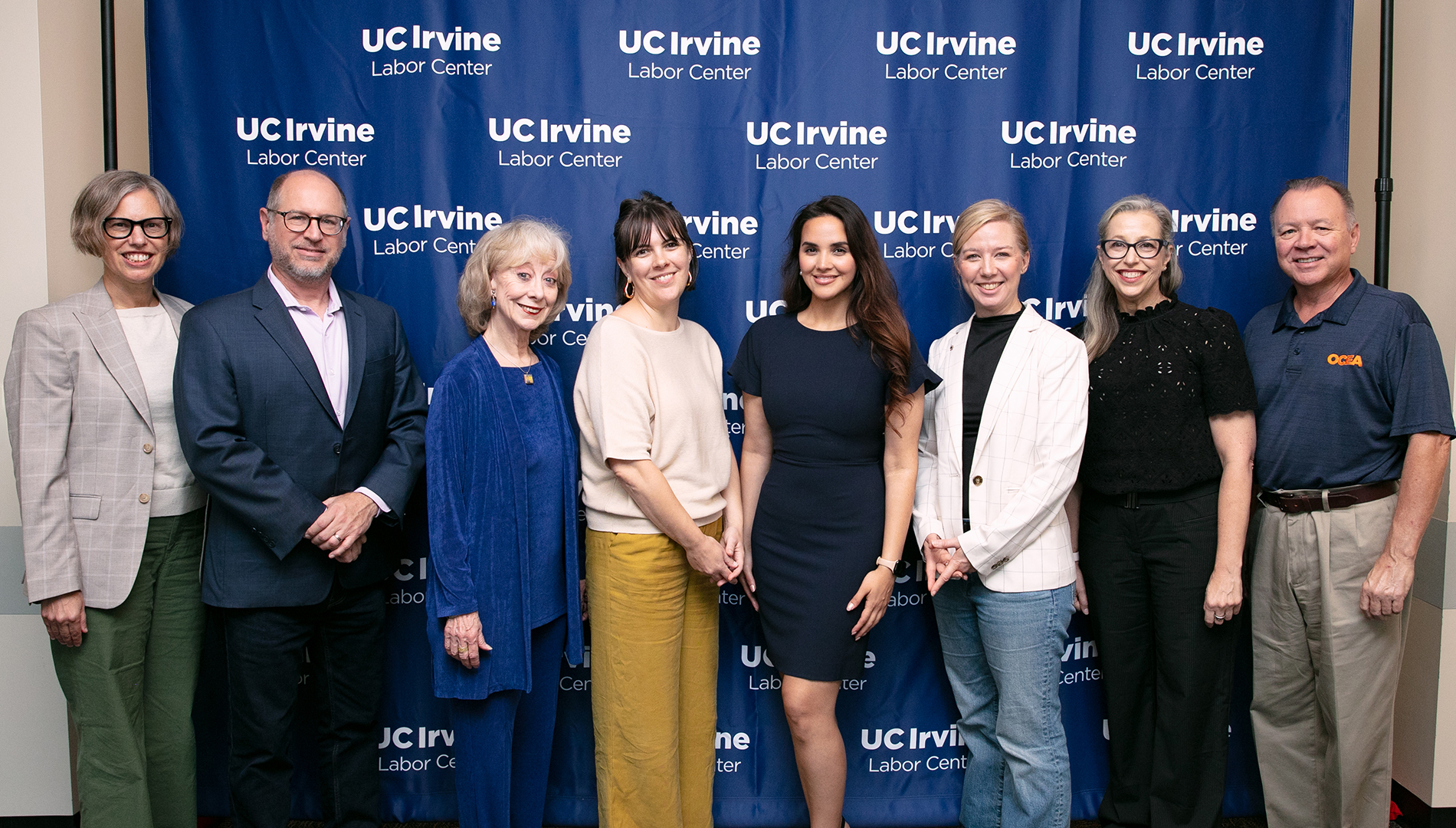
“Hollywood & Labor: AI, Technology, and the Future of Work in the Entertainment Industry” panelists from left, above, Ellen Crawford, Jillian Arnold, Miranda Banks, Kate Fortmueller and Jack Lerner. Shown below with panelists are, far left, Film & Media Studies Associate Professor Allison Perlman; center, Labor Center Research Director Iza Camarillo; far right, Orange County Employees Association General Manager Charles Barfield. Bottom, Crawford and Lerner make points. Photos by Han Parker
Scholars and union leaders lay out the threats — and the remedies — as AI transforms the entertainment industry
By Matt Coker
Inside a packed UC Irvine conference room, the atmosphere was charged with a heavy mix of anxiety and quiet resolve. Outside, Southern California’s entertainment ecosystem was still reeling from years of structural upheaval, but inside, a room full of academics, labor organizers, students, and industry veterans gathered for a critical conversation: “Hollywood & Labor: AI, Technology, and the Future of Work in the Entertainment Industry.”
Co-hosted by the UCI Labor Center, the School of Humanities’ departments of English and Film & Media Studies, and Illuminations: The Chancellor’s Arts & Culture Initiative, the event brought together a powerhouse panel to tackle one of the defining crises of modern creative life. The central question hung visibly in the air: Can human craft survive when algorithms dictate the frame?
Moderator Iza Camarillo, the Labor Center’s research director, asked the experts penetrating questions aimed at understanding where artificial intelligence is taking Hollywood. Panelists agreed that one must first look at how the industry got broken in the first place.
Media scholars Miranda Banks of Loyola Marymount University and Kate Fortmueller of Georgia State University grounded the discussion in crucial historical context. The co-authors of Boom to Bust: How Streaming Broke Hollywood Workers (University of California Press, 2026) highlighted how the streaming era had already dismantled traditional compensation models and residual structures long before generative AI entered the scene.
“AI didn’t land in a vacuum; it crashed into an industry already fractured by the streaming gold rush,” Banks observed, emphasizing that technological disruption in Hollywood is part of a longer continuum of corporate consolidation and worker devaluation.
Fortmueller echoed this sentiment, drawing attention to the invisible mechanics of production. “Behind every seamless digital interface is an army of precarious human labor trying to keep up with impossible production cycles,” she noted, reminding the audience that technological efficiency often comes at the direct expense of worker sustainability.
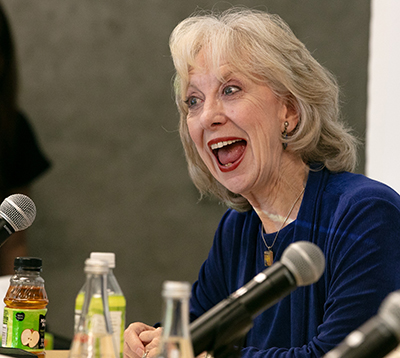 As the conversation turned from systemic economics to personal impact, SAG-AFTRA representative and veteran actress Ellen Crawford (ER, Boomers) brought the human cost into sharp focus. For performers, generative AI represents an existential threat to personal identity and artistic ownership — from unauthorized voice cloning to digital likenesses generated without fair compensation or explicit consent. Crawford spoke passionately about the grueling contract fights that defined recent labor strikes, emphasizing that protecting human identity is non-negotiable.
“Our faces and voices are not raw data points for an algorithm — they are the core of human storytelling,” Crawford stated, capturing the room with a firm reminder that acting is an irreplaceable act of human empathy, not merely training data for a machine learning model.
Yet the threat extends far beyond the faces on screen. Representing the vital “below-the-line” workforce — the editors, visual effects artists, technicians, and crew members whose hands literally construct the physical and digital worlds of cinema — Jillian Arnold, Labor & Tech Intelligence Officer with the International Alliance of Theatrical Stage Employees (IATSE), offered a pragmatic, boots-on-the-ground perspective.
Arnold (Hell’s Kitchen, MTV Video Music Awards) stressed that workers are not tech-averse Luddites; rather, they are fiercely defensive of craft integrity and fair labor practices.
“Below-the-line workers aren’t opposed to new tools, but we refuse to let technology be used to erase the human craft that builds these worlds,” Arnold declared.
She went on to detail how IATSE is actively monitoring emerging technologies, ensuring that technical crews receive tech literacy training and maintain a seat at the bargaining table regarding how automated tools are deployed on set.
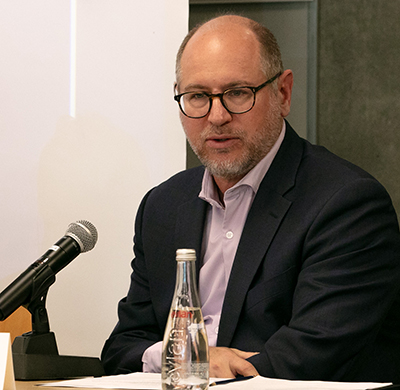 Turning toward concrete remedies, UCI School of Law Professor Jack I. Lerner, who co-authored Rap on Trial: A Legal Guide for Attorneys with Chancellor’s Professor Charis Kubrin, provided the legal and policy framework required to navigate this uncharted territory. Lerner dissected the intricate web of copyright law, fair use, and data privacy, arguing that existing legal paradigms are ill-equipped for generative AI without proactive judicial and legislative intervention.
“Law moves slowly, but collective bargaining and smart copyright policy must act as the guardrails before technology completely outpaces worker rights,” Lerner argued, pointing to enforceable consent requirements, algorithmic transparency, and legislative protections as crucial weapons in the labor toolkit.
As the discussion wound down, a clear consensus emerged across academia, performative arts, technical labor, and the law. AI may be reshaping the entertainment landscape, but its trajectory is not set in stone. The remedies lie in collective action, bold policy reform, contract enforcement, and an unwavering commitment to human dignity in creative work.
As the audience filed out into a blazing hot Irvine afternoon, the lingering takeaway was not one of despair, but of solidarity—a shared belief that by standing together, Hollywood’s workers hold the power to shape the future of work on their own terms.
Watch the full panel discussion on YouTube.