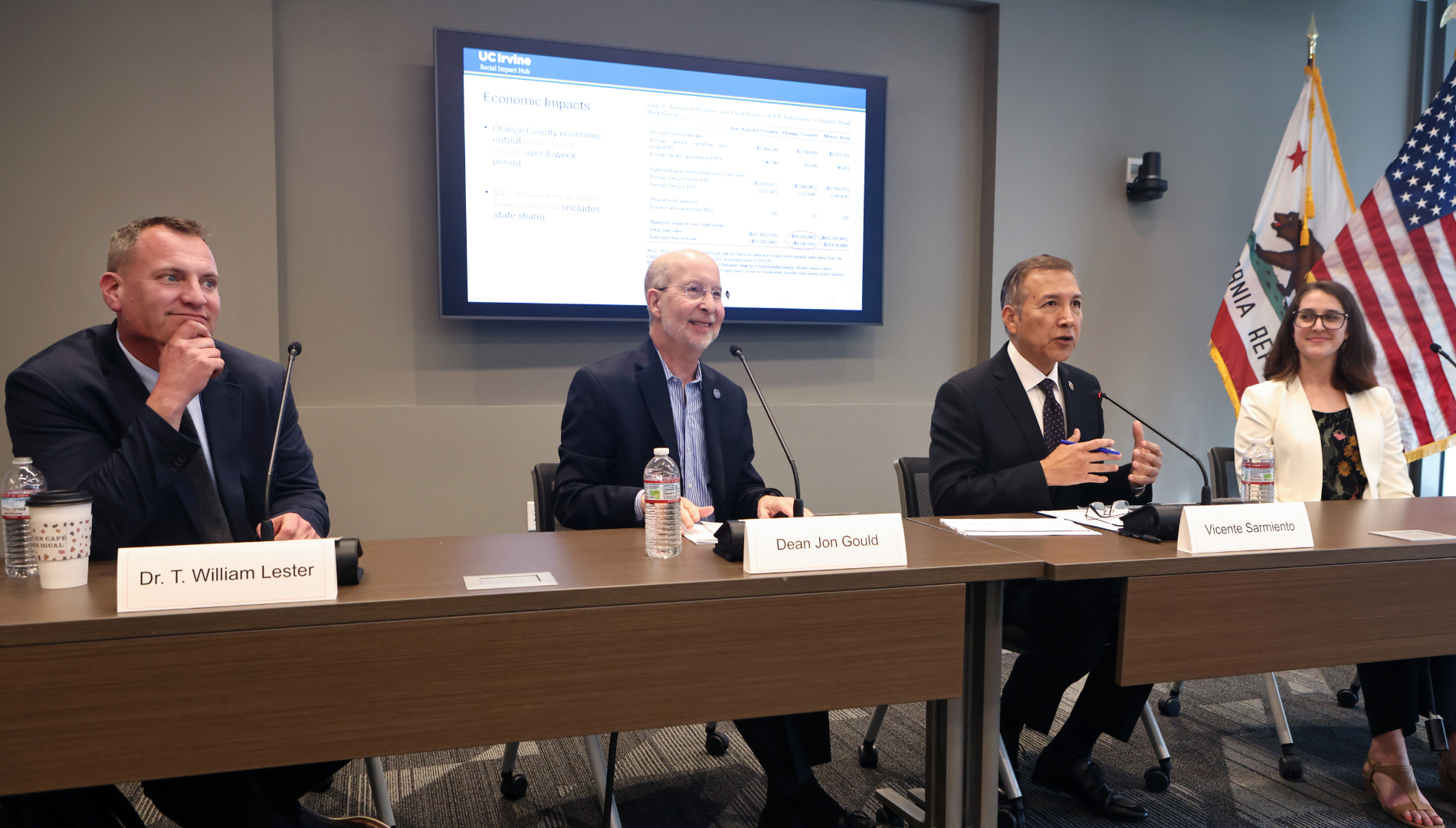
A room full of business leaders listened to, pictured above from left, T. William Lester, Dean Jon Gould, Orange County Supervisor Vicente Sarmiento and Raiven Greenberg present the findings from a survey on the impacts of immigration and tariff policies. Photos by Karen Tapia
Research reveals widespread economic decline, business owner concern
Orange County businesses lost nearly $59 million in economic output over eight weeks following intensified federal immigration enforcement, according to a UC Irvine working paper led by T. William Lester, associate professor of urban planning and public policy.
 The paper, co-authored with Eli Knaap, assistant professor of urban planning and public policy and Matthew Wilson, associate director of economic and workforce development at the Great Cities Institute at the University of Illinois, Chicago, follows a comprehensive new survey released today by UC Irvine School of Social Ecology’s Social Impact Hub and Orange County Supervisor Vicente Sarmiento. The survey, which gathered responses from 375 Orange County business owners and executives between September and October, paints a stark picture of an economy under strain.
More than half of the Economic Impact Survey’s respondents disapproved of immigration enforcement policies (55.5 percent) and proposed tariff policies (53.4 percent), with many reporting tangible impacts on their bottom lines — from decreased foot traffic to complete closures.
The financial toll has been staggering, the survey’s researchers and Sarmiento emphasized during a public discussion of the poll findings in Santa Ana.
Chilling effect
As a follow-up study to the survey, researchers used detailed cell phone mobility and spending data to quantify what they term the "chilling effect" of enhanced Immigration and Customs Enforcement (ICE) activities.
"We are finding a clear negative impact on neighborhood economies," said Lester, associate professor of urban planning and public policy, who led the research. "From our preliminary results, Orange County lost $58.9 million over just an eight-week period following the May 2025 ICE raids. That translates to $4.5 million less in sales tax revenue for our local governments. When you combine that with the uncertainty created by tariff policies, many businesses are facing an economic crisis they say is worse than what they experienced during the COVID-19 pandemic."
Indeed, one retail business owner in Orange echoed that sentiment in the survey: "I had to close. This is worse than Covid when at least there were some stimulus programs. These decisions are going to be the end of small businesses like mine that source ethically and pay labor."
Raiven Greenberg, policy coordinator for the Social Impact Hub who created the survey alongside Supervisor Sarmiento’s office, said business owners across Orange County are reporting similar challenges.
"What we're hearing from businesses is deeply concerning," Greenberg said. "Owners in sectors from hospitality to retail are telling us that their customers are afraid to come out. One hospitality business in Santa Ana told us it has 80 percent less foot traffic. A restaurant told us it cannot raise prices enough to cover the costs of food. Another said simply, 'Customers are afraid to come out and spend money due to ICE raids.' These aren't just numbers — these are real businesses, many family-owned, that are struggling to survive."
The preliminary research following the survey showed spending in neighborhoods with high concentrations of foreign-born residents from Latin America decreased by 20-25 percent in the eight weeks following May 15, 2025, when ICE announced major arrests in the region.
Among businesses that disapproved of immigration enforcement policies, 31 percent reported decreased employee morale, 17 percent saw decreased productivity, and 14 percent experienced increased absenteeism.
Business owners from Santa Ana to Anaheim reported similar concerns: "Our downtown is extremely slow, and fewer people visit because they are afraid," one hospitality business owner stated.
The impact crossed demographic and industry lines. Education and information/technology sectors showed the highest disapproval rates (80 percent), while manufacturing, construction, and banking sectors also showed significant concern. Even among those who supported stricter enforcement in principle, many acknowledged the economic pain.
Overwhelming uncertainty
Adding to the economic strain, proposed federal tariff policies have created what survey respondents called a climate of "overwhelming uncertainty."
Sarmiento explained he commissioned the survey to understand how federal immigration policies, new tariffs and widespread fear were impacting local businesses, workforce decisions, and economic planning.
The effects have been widespread across the community, particularly in his district. Federal immigration enforcement actions have occurred in local neighborhoods, including what he described as a military occupation near his home. On the same day as the survey release, the downtown merchant area known as Calle Cuatro was raided, with workers detained and displaced.
"You see the streets are dormant, businesses are empty, people are scared and people are hiding," Sarmiento said. "That is not a formula for a healthy workplace."
Among businesses that disapproved of tariff policy, 54 percent reported increased prices for business inputs, 39 percent saw decreased demand for their products, and 38 percent expressed reluctance to make hiring or investment decisions due to policy unpredictability.
"Tariffs are a problem that is manageable, but the main impact is the economic uncertainty caused by indecisive tariff policies," explained one retail business owner in Orange. "Retail customers have stopped purchases that can wait, suppliers have not replenished warehouses due to varying tariffs month to month."
A restaurant owner in Santa Ana was even more blunt: "If I raise my prices, I will lose even more customers."
Another business owner in the arts and entertainment sector in Santa Ana reported: "We might face closure by the end of this year. We will have to make a hard decision at the end of this month."
Taking the pulse of OC
The survey represents a collaborative effort between Supervisor Sarmiento's office and UC Irvine's Social Impact Hub, distributed through more than 25 local chambers of commerce, nonprofits, and trade groups across the county.
"The UC Irvine School of Social Ecology has a long-standing commitment to engaged research that serves our community," said Jon B. Gould, dean of the School of Social Ecology. "This survey is a perfect example of how we work to take the pulse of Orange County — not just to document problems, but to provide actionable recommendations for solutions. Our faculty use rigorous scientific methods and analysis to understand what's happening on the ground in real-time. This allows policymakers, business leaders and community organizations to respond with evidence-based solutions."
By partnering with Sarmiento's office and leveraging the school’s extensive network of community partners, “we're able to reach businesses across every sector and community in Orange County,” Gould added. “That's how we develop a true understanding of countywide challenges and craft recommendations that can make a real difference."
Pursuing solutions
Speaking of recommendations, business owners who participated in the survey offered suggestions for addressing the crisis:
- "Provide hardworking people a path for citizenship," urged a manufacturing business owner operating in 17 Orange County communities.
- "Help small businesses with loans or grants," requested a retail business owner in Orange.
- "Quit this fear mongering in the streets. Have due process for people. [We need] support from government officials speaking out against these inhuman practices," wrote a professional services business owner in Orange.
- "Help us provide red cards, advocacy material and know your rights workshops at our location for our community. Also, relief funds and grant opportunities," requested an arts and entertainment business owner in Santa Ana.
- Several respondents emphasized the need for multilingual outreach, with one education industry professional noting: "Provide updates to small businesses in Spanish and Vietnamese."
- For tariff-related challenges, businesses called for policy stability, financial relief programs including grants (not loans), and support for "buy local" campaigns to help redirect consumer spending.
The survey included respondents from all cities in Orange County, with representation across industries including retail (17.2 percent), professional services (14.6 percent), banking and finance (14.2 percent), hospitality (13 percent), healthcare (11.6 percent), and manufacturing (11.2 percent).
The respondent pool included 81 percent small businesses with 1-10 employees, closely matching Orange County's actual business demographics. Respondents were 56 percent male, 40 percent female, with 70 percent born in the United States and 25 percent born outside the U.S. The survey included significant representation from Hispanic/Latino (25.2 percent), white (52.6 percent), and Asian (10.5 percent) business owners.
— Mimi Ko Cruz
Watch the Economic Impact Survey Results presentation on YouTube.
Economic Impact Survey Results