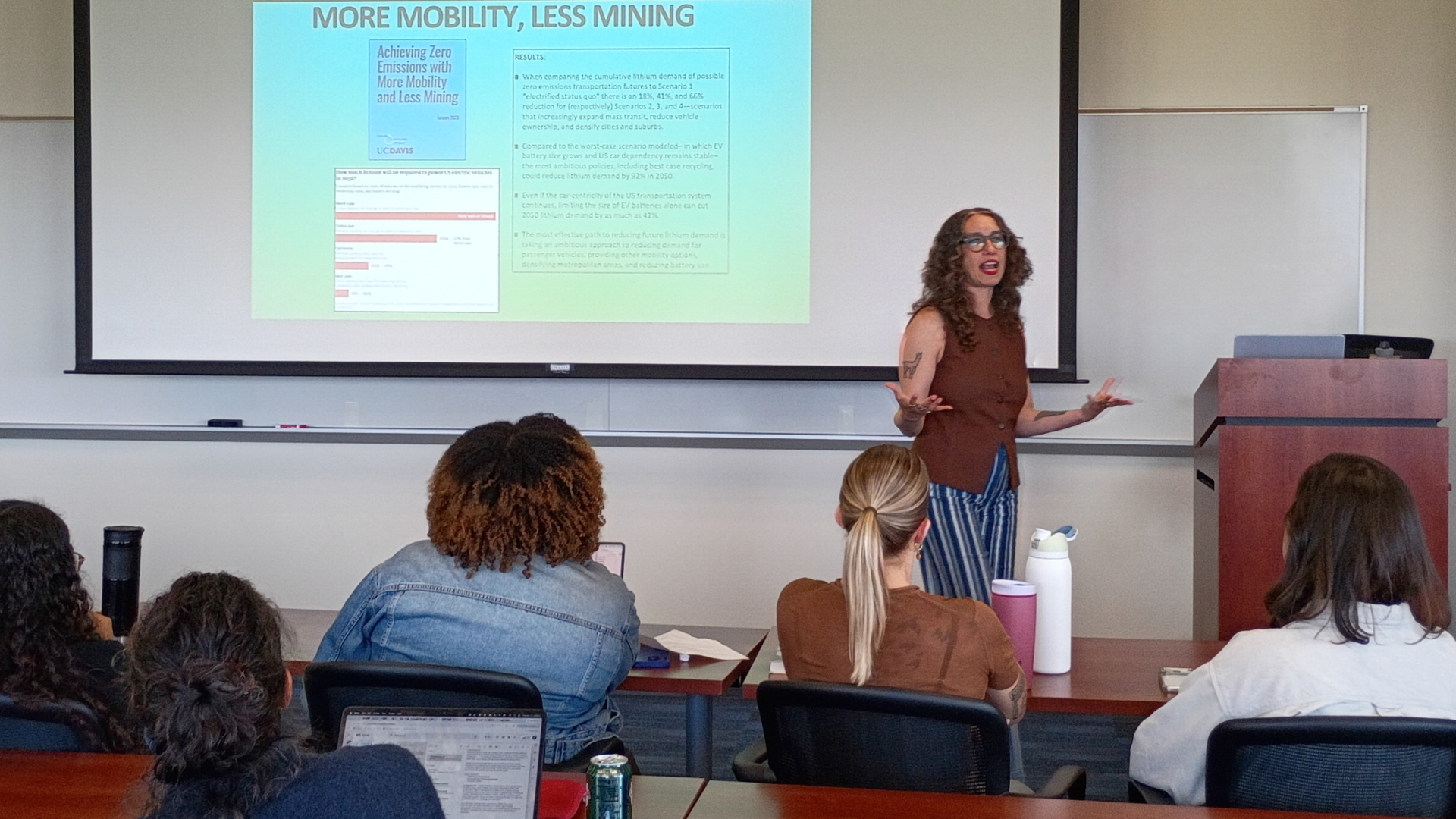
Providence College's Thea Riofrancos talks about the fallout from the global demand for lithium. Photo by Han Parker
From the frontlines of lithium extraction to a shared interdisciplinary vision
When we picture the transition to a clean energy future, we often envision sleek electric vehicles, sprawling solar arrays, and wind turbines stretching across pristine landscapes. But during Thea Riofrancos’ May 27 visit to UC Irvine, the Providence College associate professor of political science urged her audiences to peer beneath the glittering surface of green capitalism and confront a messy, extractive reality.
The strategic co-director of the public policy think-tank the Climate and Community Institute, Riofrancos brought her incisive scholarship to bear on pressing environmental and public policy questions during the final lecture of the 2026 Climate Justice Lecture Series. Facilitated by the Department of Urban Planning and Public Policy, the Climate and Urban Sustainability Program, the School of Social Ecology’s Social Impact Hub and the UC Irvine Alec Glasser Center for the Power of Music & Social Change, the Climate Justice Lecture Series has engaged speakers, students, faculty, staff, and community members in conversations about some of the most pressing social and environmental issues of our time. While past speakers focused on the intersections of housing, labor, and environmental justice in climate related policies, as the final speaker, Riofrancos sketched out the possible stakes of a green energy transition.
Drawing from her extensive field research in Latin America and her latest book, Extraction: The Frontiers of Green Capitalism (2025, W. W. Norton & Co.), Riofrancos unpacked the compounding global demand for critical minerals required to build low-carbon infrastructures and consumer commodities.
At the center of her presentation was lithium—the essential bedrock of modern battery technology. Riofrancos illustrated how the global rush to secure this “white gold” replicates older, violent patterns of resource exploitation. From the high-altitude salt flats of Chile to the sacred lands of Nevada, she documented the deleterious impacts of lithium mining on frontline and Indigenous communities. These operations frequently deplete fragile water tables, degrade ecosystems, and bypass local democratic consent, forcing vulnerable populations to bear the ecological burdens of a decarbonization strategy designed for wealthy urban centers.
“What justifies, quote-unquote, all this harm?” the scholar asked rhetorically. “It’s a very unique landscape, we have human culture, we have animals, non-human nature, astounding beauty. Why destroy all this for the lithium? Why is the lithium so important?”
Noting it was not long ago that people only associated lithium as a mood-stabilizing drug, Riofrancos revealed that the substance is now in demand for two burgeoning production sectors: electric vehicles and data centers. And one of the largest procurers is the defense industry.
Yet, her talk was far from an exercise in despair. Instead, she offered a rigorous, actionable framework for a socially just green transition. Pointing to the findings of her influential report, “Achieving Zero Emissions with More Mobility and Less Mining,” Riofrancos demonstrated that massive environmental destruction is not inevitable. By shifting public policy to incentivize robust green public transit systems rather than merely replacing gasoline cars with heavy personal electric vehicles, governments can radically curb the global demand for lithium extraction. Such a shift would simultaneously relieve pressure on Indigenous territories and deliver immediate, tangible benefits to transit-dependent urban communities at home.
Professor Riofrancos’s expertise on critical mineral supply chains, green transportation, and energy transitions resonated with students across disciplines. In a graduate student workshop that preceded her talk, Professor Riofrancos engaged directly with students analyzing energy transitions and environmental conflicts across China, the Philippines, Latin America, and the U.S., with her expertise providing a vital analytical anchor. Stimulated by her findings, students set to work crafting policy memos addressed to the United Nations Environmental Program, examining how American transportation policies reverberate across global supply chains and looking for ways to protect Global South communities.
A blueprint for collective justice
Riofrancos’ presentation served as a capstone for a broader, deeply integrated intellectual project. Over four intense sessions, the Climate Justice Lecture Series drew more than 100 undergraduate students, 30 master’s candidates, and 12 Ph.D. scholars. The overarching goal was ambitious: to connect academic research to active policy and grassroots campaigns, equip students with analytical tools to assess structural inequities, and foster a truly interdisciplinary dialogue that bridged urban planning, sociology, political science, and environmental studies.
By looking backward from Riofrancos' final talk, the cohesive blueprint of the entire series comes into sharp focus. Each speaker provided an essential pillar for understanding how climate change intersects with socio-economic inequality. For instance, Daniel Aldana Cohen, an assistant professor of sociology at UC Berkeley, had opened the series by challenging students to think about spatial and housing justice. His public-facing research, which famously guided federal proposals like the Green New Deal for Public Housing Act, inspired students to draft opinion editorials examining the intersection of housing crises and carbon emissions, evaluating how retrofitting public housing could simultaneously eradicate toxic materials and build local green union apprenticeships.
Building on themes of economic equity, J. Mijin Cha of UC Santa Cruz and Cornell University’s Climate Jobs Institute provided the labor perspective. Her scholarship on the “just transition” agenda illustrated how to move away from fossil fuels without abandoning working-class communities. Students engaged with her research by dissecting a case study of an electric bus manufacturing facility in Alabama, where labor unions and civil rights groups utilized a Community Benefits Agreement to secure high-quality manufacturing jobs for historically marginalized residents.
Finally, Distinguished Professor at UC Santa Barbara, David N. Pellow, underscored the systemic patterns of environmental racism and drew from his decades of service on grassroots organizations to show how social movements can transform institutions. Reading movements like Black Lives Matter as climate justice struggles, Professor Pellow argued that the struggle for climate justice must treat all workers as essential and redress intersecting social harms of race, gender, ability, and class.
In his concluding remarks, series moderator and Assistant Professor of Urban Planning and Public Policy Mukul Kumar expressed that “it is hoped that the series will continue through our collective conversations, organizing, and research that is inspired by the speakers’ call for envisioning climate justice in ways that foreground the demands of Indigenous, frontline, and working peoples across the world.”
Ultimately, what UC Irvine learned from this lecture series is that climate justice cannot be achieved in a silo. From housing equity and union-backed manufacturing to international mineral supply chains, every element of the low-carbon transition is deeply intertwined. By translating the insights of scholars like Riofrancos into tangible policy memos, op-eds and case studies, the next generation of urban planners and policymakers left the series equipped with the exact multi-layered, interdisciplinary tools needed to build a future that is not only green, but profoundly just.
— Matt Coker