
T. William Lester, associate professor of urban planning and public policy, at a community event speaks about the toll of recent ICE raids in Los Angeles and Orange counties. Photo by Karen Tapia
New policy brief recommends stopping indiscriminate, warrantless stops that amplify community fear
Researchers at the University of California, Irvine and University of Illinois, Chicago have released a policy brief showing that aggressive federal immigration enforcement carries a steep and measurable economic price — one that is ultimately paid by local businesses, neighborhood residents and the governments that serve them.
The brief, produced by T. William Lester and Eli Knaap, faculty members in UC Irvine’s Urban Planning and Public Policy Department along with Matthew Wilson of the University of Illinois Chicago, analyzes what happens to local economies when Immigration and Customs Enforcement ramps up operations in immigrant communities. Their answer: a swift and lasting economic contraction that extends far beyond anyone actually targeted by federal agents.
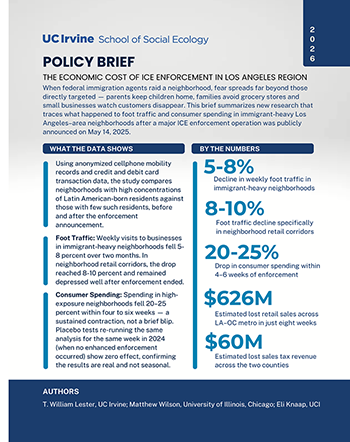 The researchers focused on a major ICE operation announced on May 14, 2025, in which federal agents reported arresting 239 people in the Los Angeles area.
Using cellphone location data and anonymized consumer spending records, they tracked economic activity in immigrant-heavy neighborhoods before and after the announcement and compared it to neighborhoods with few immigrant residents.
The results were significant. In the eight weeks that followed, foot traffic in immigrant-dense retail corridors fell by 8 to 10%. Consumer spending dropped by 20 to 25%.
Scaled across Los Angeles and Orange Counties, the researchers estimate the enforcement campaign resulted in more than $625 million in lost retail sales and nearly $60 million in foregone sales tax revenue — all in just two months.
The researchers also note that because undocumented and mixed-status households are less likely to use the credit and debit cards captured in their dataset, the true economic impact is probably even larger than what they measured.
“Fear of immigration enforcement — more than any other factor — drove the economic drop,” Lester says.
The brief's core message to policymakers is straightforward: immigration enforcement is not a costless federal action. The economic fallout lands on state and local governments through lost tax revenue, and on small businesses and workers in immigrant communities who have no connection to enforcement activity at all.
The researchers describe this as a “chilling effect” — a well-documented phenomenon in which enforcement causes widespread fear and behavioral change that ripples far beyond those directly targeted.
“When residents fear leaving their homes, they shop less, eat out less, and limit patronizing local businesses,” Lester points out. “As a result businesses lose revenue and local governments lose tax dollars.”
The policy brief calls for several responses:
- Federal transparency: ICE should provide greater advance notice to local governments about the timing and scale of enforcement operations so communities can prepare for the economic consequences.
- Fiscal accountability: State and local governments should have formal tools to document and seek remedy for revenue losses caused by federal enforcement actions.
- Impact assessments: Large-scale interior enforcement operations should require community economic impact reviews, similar to those required for major federal infrastructure or environmental decisions.
The Los Angeles operation sparked large protests, clashes between demonstrators and federal agents, and the deployment of National Guard troops and U.S. Marines to the region — events that kept fear elevated in immigrant communities for weeks, Lester notes.
“These broader economic spillovers should be central to debates over the design and implementation of immigration enforcement policy,” the researchers write. “The costs are not abstract. They show up in lost revenue, weakened neighborhood economies, and reduced public services.”
Their research is documented in a working paper currently under review for academic journal publication.
— Mimi Ko Cruz