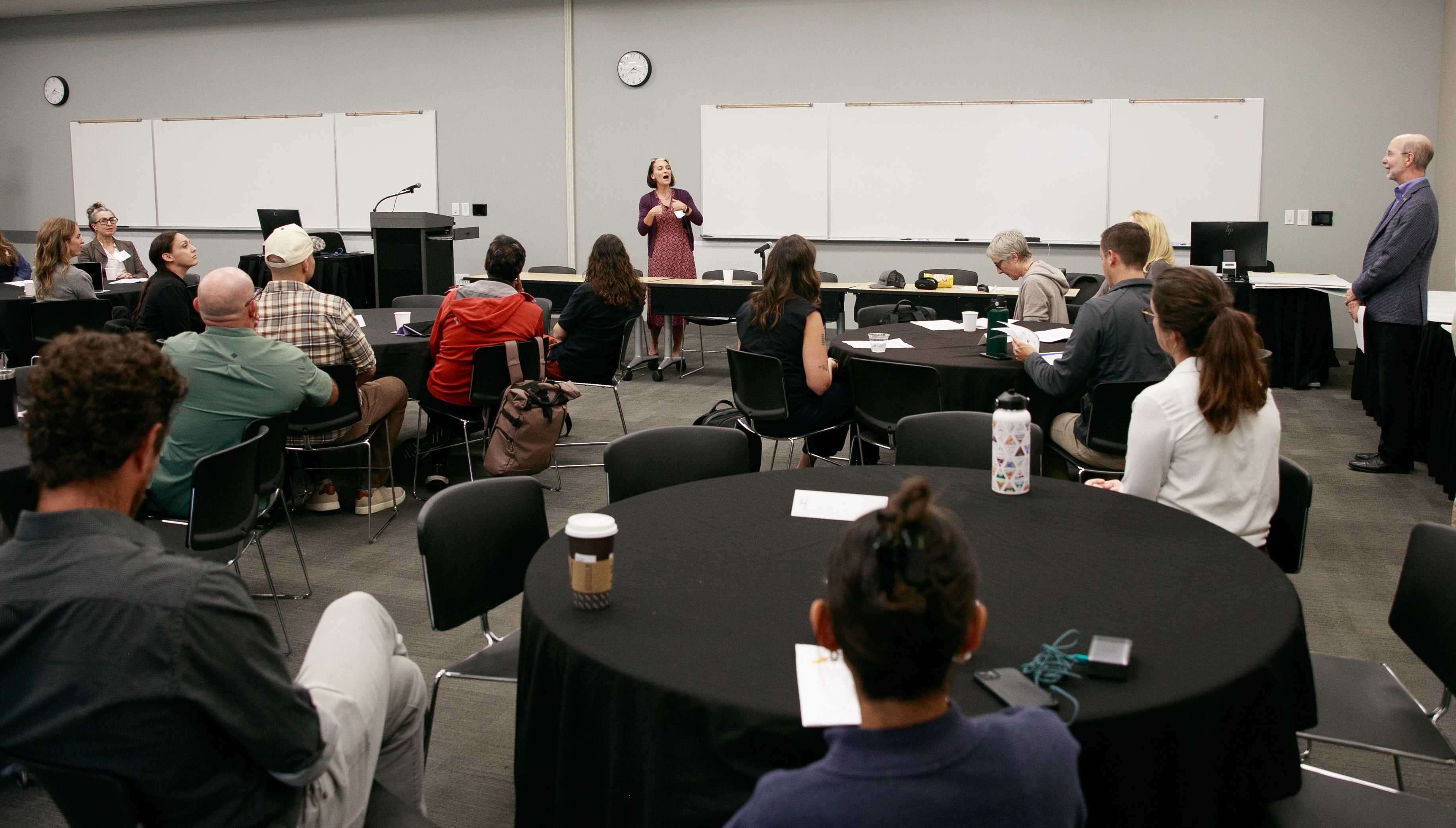
Professor Keramet Reiter welcomes participants to the recent California Coalition for Higher Education in Prison Fall Convening on campus.
Educators from across California convene to transform higher education inside state prisons
By Mimi Ko Cruz
Jennifer Gomez knows what a college education can do for someone who has been behind bars. She lived it.
Now, as assistant director of UC Irvine’s LIFTED (Leveraging Inspiring Futures Through Educational Degrees), the first in-prison BA-degree completion program in the University of California system, and one of the organizers of a landmark statewide convening that wrapped up Oct. 23 on campus, she is fighting to make sure every incarcerated student in California gets what she got — not just a degree, but belonging, leadership and a reason to imagine a future.
That conviction helped drive the two-day California Coalition for Higher Education in Prison (CCHEP) Fall Convening, which brought together more than 40 educators, administrators, advocates and practitioners for relationship-building, strategy and a shared reckoning with what it actually takes to provide a quality college education behind prison walls.
Representatives from every public higher education system in California — private college, community colleges, California State Universities, and University of California campuses — gathered to strategize together. The event was organized by UCI’s LIFTED program, directed by Keramet Reiter, professor of criminology, law and society, alongside a core team of long-standing higher education in prison practitioners from across the state. The UCI Social Impact Hub provided logistical support and sponsorship.
The convening built on momentum from a landmark legislative hearing held inside Richard J. Donovan Correctional Facility in 2024 — one of the only times in decades that California legislators convened inside a state prison.
For Reiter, the significance of that moment was unmistakable.
“To me, it first and foremost represented legislative awareness of and attention to the challenges of providing programs inside state prisons,” she said. “Taking the time to get a security clearance, travel to often-rural locations, and navigate the limitations on internet and technology access in prison all require a significant investment, which state legislators willingly made in order to not just hear about prison education but see it first-hand.”
But Gomez was careful to place that hearing in a longer arc of advocacy, noting that community organizers had laid important groundwork — bringing legislators, judges and practitioners inside the facility before the formal hearing — and that many states have well-established coalitions California can learn from.
“It is important to recognize the work and relationships that preceded these more visible milestones,” she said.
California’s public higher education system was designed as an integrated ladder — community college to CSU to UC — but for incarcerated students, the rungs often have been missing or misaligned. Geographic isolation, inconsistent advising and institutional siloes have made transfer pathways difficult to navigate even for the most motivated students.
Reiter sees an unexpected opportunity in that challenge.
“I often say that the faculty and staff supporting incarcerated students in California are going to be the ones who solve the long-standing challenges that have faced students attempting to transfer between community college, CSU and UC programs,” she said. “In the prison higher education space, teams are working closely together to streamline transfer pathways, identify shared interests, and coordinate to advocate together for the resources they need. This is novel.”
Among the priority issues on the table: expanding technology and computing access for incarcerated students; guaranteeing physical space inside facilities for courses and academic support; and creating a statewide educator-led coalition to coordinate policy across California's prison system.
Reiter said she hopes participants left with something that cannot be captured in a policy brief: community, “a deeper familiarity that ensures they have multiple people they can call whenever they face a challenge, whether with an education question about how to support a student needing one more class to transfer, or with a correctional policy question about how to ensure students have access to the resources they need to succeed.”
The grassroot coalition’s long-term vision spans four areas: policy and law; programmatic development and integration; professional development; and data and research.
Success in five years, Reiter said, would mean regular convenings, a shared mission statement and meaningful wins on policy and funding at the state and legislative levels.
For Gomez, the stakes are foundational.
“The relationships, leadership opportunities, career exploration and community engagement I experienced helped me build confidence, find belonging and imagine a future,” she said. “Those experiences were not extras — they were foundational.”
Her vision for the coalition goes beyond degrees and transcripts.
“Incarcerated students are not an additional burden on university resources,” she said. “They are members of our university communities whose potential deserves meaningful investment.”