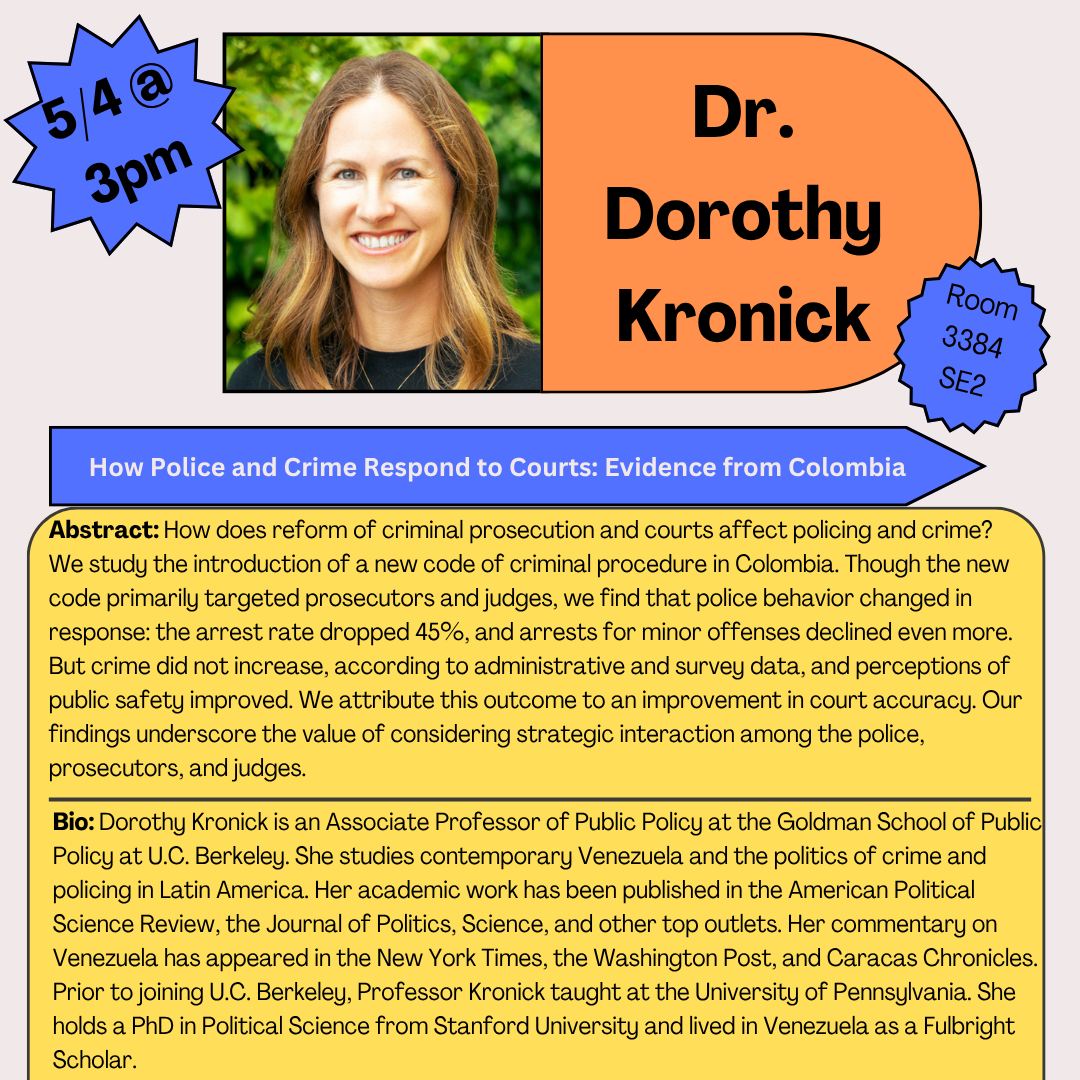
To learn how reform of criminal prosecution and courts affect policing and crime, Dorothy Kronick studied the introduction of a new code of criminal procedure in Colombia. Though the new code primarily targeting prosecutors and judges, her research found that police behavior changed in response: the arrest rate dropped 45%, and arrests for minor offenses declined even more. But crime did not increase, according to administrative and survey data, and perceptions of public safety improved. This was attributed to an improvement in court accuracy. These findings underscore the value of considering strategic interaction among the police, prosecutors, and judges.
Dr. Kronick is an associate professor of public policy at the Goldman School of Public Policy at U.C. Berkeley. She studies contemporary Venezuela and the politics of crime and policing in Latin America. Her academic work has been published in the American Political Science Review, the Journal of Politics, Science, and other top outlets. Her commentary on Venezuela has appeared in the New York Times, the Washington Post, and Caracas Chronicles. Prior to joining UC Berkeley, Professor Kronick taught at the University of Pennsylvania. She holds a PhD in political science from Stanford University and lived in Venezuela as a Fulbright Scholar.
At this event, light refreshments will be served; please RSVP so we can get a head count.